Northrop A-17A
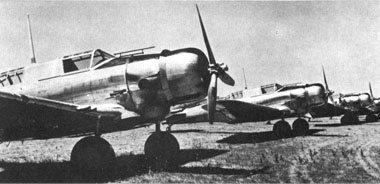
The Northrop A-17A was a single-engined attack aircraft of 1936 vintage, whose active role in the Army Air Corps was mostly over by the time war broke out. A-17As saw unit service with the Army for less than four years. In June 1940, all but 20 A-17As were sold overseas to England and France. The remaining Army Air Forces A-17 and A-17As were used as advanced trainers and squadron support aircraft, most ending up as ground maintenance trainers. The last A-17A was written off of Army Air Forces records in early 1945.
Type:           attack aircraft
Crew:           2
Armament:       four fixed .30-cal machine guns
		one flexible mount .30-cal machine gun
		up to 1,100 lbs. of bombs
Specifications:
        Length:         31 ft. 8 in.
        Height:         9 ft. 3 in.
        Wingspan:       47 ft. 9 in.
	Wing area:	363 sq. feet
        Weight:   	7,543 lbs. maximum

Propulsion:
        No. of Engines: 1
        Powerplant:     Pratt & Whitney R-1535-13
        Horsepower:     825 hp

Performance:
        Range:          732 miles
        Cruise Speed:   170 mph
        Max Speed:      220 mph
        Ceiling:        19,400 ft.
Douglas A-20 Havoc
also: P-70 Nighthawk night fighter,
French DB-7
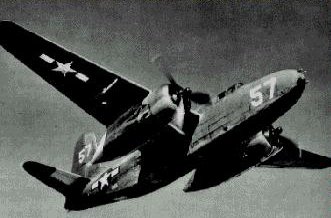
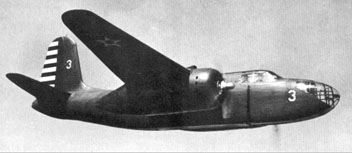
The Douglas A-20 Havoc light bomber was one of the most extensively built of the light bombers of WWII. It was used in a variety of roles, performing them well but without distinction. Initially configured with a standard bomber glass nose, some later versions had a solid nose containing multiple machine guns for use in low-level attacks. Some A-20s equipped with radar equipment were redesignated as P-70s and were used as night fighters until replaced in 1944 by the P-61 "Black Widow". The P-70 was given the name Nighthawk, though this name was rarely used. A further variation of the A-20 was the F3-a, which was the photo recon variant. The Havoc was known as the Boston Mark III to the British (who also used it in various theaters), and as the DB-7 to the French.
Type:           Light Bomber
Crew:           three
Armament:       seven .50 cal machine guns
                up to 4000 lbs. of bombs

Specifications:
        Length:         47' 11" (14.6 m)
        Height:         17' 7" (5.36 m)
        Wingspan:       61' 4" (18.69 m)
        Wing area:      464 sq. ft (43.10 sq. m)
        Empty Weight:   16993 lb (7706 kg)
        Gross Weight:   24127 lb

Propulsion:
        No. of Engines: 2
        Powerplant:     Wright R-2600-23
        Horsepower:     1600 hp each

Performance:
        Range:          945 miles (1521 km)
        Cruise Speed:   256 mph ( 412 km/h)
        Max Speed:      317 mph ( 510 km/h)
        Ceiling:        23700 ft (7223.40 m)
Douglas A-24 Banshee
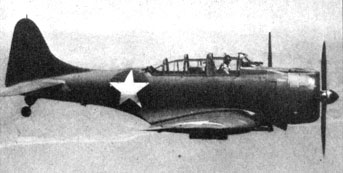
The A-24 was the Army version of the famous Navy dive bomber known as the SBD
Dauntless. Look under USA's Dive and Torpedo Bombers
Curtiss A-25 Shrike / Helldiver
The A-25 was the Army version of the Curtiss SB2C Helldiver. Initially named the "Shrike", it later was called by the Navy name "Helldiver".Army version of SB2C-1 Helldiver carrier-
based dive bomber. Larger wheels, no arrestor gear, no folding wings. One Wright R-2600 radial, crew of 2.
Four .50-cal guns in wing, one flexible 0.30-cal gun in rear cockpit. Speed: 285 mph at 12,400 ft. Range: 1090 miles with 2000-lb bomb load. 900 delivered to US Army. Army eventually decided that it didn't need dive bombers, and the A-25 never entered combat. Most used as trainers and target tugs. Ten were delivered to Australia. 410 were turned over to the US Marine Corps, which used them as operational trainers under the designation SB2C-1A.
Douglas A-26 Invader
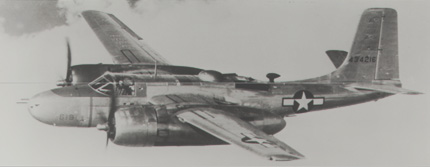
The combination of firepower and high speed made the Douglas A-26 a highly effective aircraft. Designed as a replacement for the A-20 Havoc, the A-26 met all of its specifica- tions and then some. After World War II it was renamed the B-26 (not to be confused with the Martin B-26 Marauder, which had been retired from the Air Force inventory at the end of the war), and saw service in Korea and Vietnam.
Type: Attack / Medium Bomber Crew: three Armament: six .50 cal machine guns, plus optionally eight more up to 4000 lbs. of bombs Specifications: Length: 51' 3" (16.62 m) Height: 18' 6" (5.64 m) Wingspan: 70' (21.34 m) Wing area: 540 sq. ft (50.17 sq. m) Empty Weight: 22850 lb (10365 kg) Gross Weight: 34927 lb (15873 kg) Max Weight: 35000 lb (15876 kg) Propulsion: No. of Engines: 2 Powerplant: R-2800-79 Horsepower: 2000 hp each Performance: Range: 1400 miles (2255 km) Cruise Speed: 284 mph (457 km/h) Max Speed: 355 mph (571 km/h) Ceiling: 22100 ftLockheed A-28/A-29 Hudson
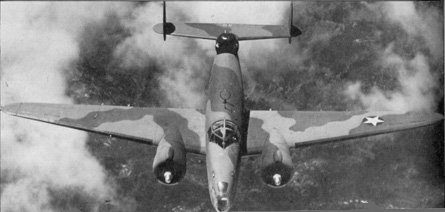
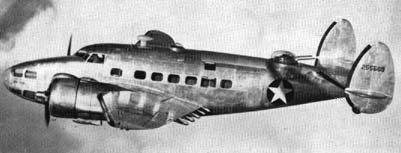
The Lockheed Hudson was the first American aircraft to be used operationally by the RAF during World War II. It was designed to meet a British requirement for a martime patrol/navigational trainer aircraft. The first 200 aircraft arrived in England in February 1939, with about 1500 total procured before introduction of the Lend-Lease program. In USAAF service the various versions served as troop transports, bomber crew trainers, photo-reconnaissance aircraft, anti-submarine patrol aircraft, trainers for air gunners, and as a target tug. Twenty examples were used by the U.S. Navy as maritime patrol aircraft under the designation PBO-1. The Lockheed AT-18 was an advanced trainer based on the Lockheed Hudson. The USAAF placed an order for 300 AT-18s on 8 May 1942. 217 aircraft were produced as AT-18-LO gunnery trainers, equipped with a Martin dorsal turret armed with twin 0.50in machine guns, while the remaining 83 aircraft were produced as AT-18A-LO navigational trainers. These aircraft had the turret removed and had space for the pilot, the instructor and three students. In all, over 2500 Hudsons were built, and many remained in service in a secondary role until the end of the war.
Type: maritime patrol bomber Crew: ? Armament: five 0.30 inch machine guns up to 1,600 lbs. of bombs Specifications:
Length: 44' 4" (13.51 m) Height: 11' 11" (3.63 m) Wingspan: 65' 6" (19.96 m) Wing area: 551 sq. ft (51.19 sq. m) Empty Weight: 12,825 lb (5817 kg) Max Weight: 20,500 lb (9299 kg) max at takeoff Propulsion: No. of Engines: 2 Powerplant: Wright R-1820-87 Cyclone 9 radial Horsepower: 1200 hp each Performance: Range: 1550 miles (2494 km) Cruise Speed: 205 mph ( 330 km/h) Max Speed: 253 mph ( 407 km/h) at 15,000 ft Ceiling: 26,500 ft (8075 m)
Martin 187 (A-30) Baltimore
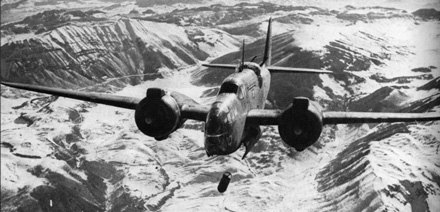
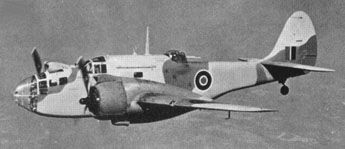
The Martin Baltimore was developed from its predecessor the Martin 167 Maryland to meet specific British
requirements. It was used with distinction by a number of Allied air forces in
Europe, and was liked by its pilots for its superior performance and great
structural strength. One drawback that it shared with the Maryland was the very
narrow fuselage, which made it virtually impossible for crew members to change
position in flight if injured.
Type:		twin-engined light bomber
Crew:		4
Armament: 	four .303 inch machine guns in wings
		2-4 .303 inch machine guns in dorsal turret
		two .30 inch machine guns in ventral position
		up to 2,000 lbs. of bombs


Specifications:
	Length:        	48' 5.75" (14.78 m)
	Height:        	17' 9" (5.41 m)
	Wingspan:      	61' 4" (18.69 m)
	Wing area:	538.5 sq. ft (50.03 sq. m)
	Empty Weight:  	15,460 lb (7013 kg)
	Max Weight: 	22,600 lb (10,521 kg) max at takeoff

Propulsion:
	No. of Engines:	2
	Powerplant:    	Wright GR-2600-A5B Cyclone 14 radial
	Horsepower:	1660 hp each

Performance:
	Range:		1082 miles (1741 km)
	Cruise Speed:   225 mph ( 362 km/h)
	Max Speed:      305 mph ( 491 km/h) at 11,500 ft
	Ceiling:       	23,300 ft (7100 m)
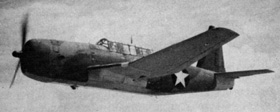
Vultee A-31/A-35 Vengeance Designed under the designation V-72, the aircraft that would
eventually be named Vengeance by the British was developed as a dive bomber by
the Vultee Corporation. One of few U.S. military aircraft who's initial
development was not aided by government finance, the V-72 was intended for sale
to export markets. Large numbers (for the time) were sold to Brazil, China,
Turkey, and the USSR during the mid-to-late 1930s. In 1940 the British purchased
700 V-72s (400 of which were manufactured by Northrop), and with the
introduction of lend-lease in 1941, the U.S. ordered 300 more examples for the
British under the designation A-31. The majority of British Vengeances served in
Burma, where they enjoyed considerable success. When the U.S. entered the war,
it commandeered 243 of the aircraft meant for Britain, and later had even more
Vengeances manufactured for the USAAF under the designation A-35.
 Type:		two-seat dive bomber
Crew:		2
Armament:	six 0.50 cal machine guns
		up to 2,000 lbs. of bombs

Specifications:
	Length:        	39' 9" (12.12 m)
	Height:        	15' 4" (4.67 m)
	Wingspan:      	48' 0" (14.63 m)
	Wing area:	332 sq. ft (30.84 sq. m)
	Empty Weight:  	10,300 lb (4672 kg)
	Max Weight: 	16,400 lb (7439 kg) max at takeoff

Propulsion:
	No. of Engines:	1
	Powerplant:    	Wright R-2600-13 Cyclone 14 radial
	Horsepower:	1700 hp

Performance:
	Range:		2300 miles (3701 km)
	Cruise Speed:   230 mph ( 370 km/h)
	Max Speed:      279 mph ( 449 km/h) at 13,500 ft
	Ceiling:       	22,300 ft (6800 m)
Douglas A-33
In the early 1930s a USAAC specification for an attack aircraft led to the development of the Northrop A-17, which was produced between 1935 and 1937. In 1939 Douglas decided to develop the Northrop design for export to foriegn nations, and identified the new version as the Model 8A. The 8A was similar to the A-17, but had a more powerful engine and a retractable tail wheel. In early 1942 a batch of 31 Model 8As intended for Peru were commandeered by the U.S. Army, and given the designation A-33. All of these aircraft were used for training purpose.
Type: two-seat attack aircraft Crew: 2 Armament: four .30 inch machine guns in the wings two .30 inch machine guns in rear cockpit up to 1,800 lbs. of bombs Specifications: Length: 32' 5" (9.88 m) Height: 9' 9" (2.97 m) Wingspan: 47' 8.75" (14.55 m) Wing area: 363 sq. ft (33.72 sq. m) Empty Weight: 5370 lb (2436 kg) Max Weight: 8949 lb (4059 kg) max at takeoff Propulsion: No. of Engines: 1 Powerplant: Wright GR-1820-G205A Cyclone 9 Horsepower: 1200 hp Performance: Range: 910 miles (1464 km) Cruise Speed: 200 mph ( 322 km/h) Max Speed: 265 mph ( 426 km/h) at 9000 ft Ceiling: 32000 ft (9755 m)
North American A-36

The A-36 was an early version of the P-51
provided with dive brakes and underwing racks, to operate in a close-support role. The A36
first flew in Oct. 1942; production of 500 A-36As was completed by March 1943. Unofficially
named "Invaders," A-36As were assigned to the 27th and 86th Bombardment Groups
(Dive), later redesignated as Fighter-Bomber Groups. In June 1943, the plane
went into action from North Africa. During the Italian campaign, A-36A pilots
flew bomber escort and strafing missions as well as ground support bombing
attacks. A-36As also served with the 311th Fighter Bomber Group in India. Dive
brakes in the wings gave greater stability in a dive, but they were sometimes
wired closed due to malfunctions. In 1944, AAF A-36As were replaced by P-51s and
P-47s when experience showed that these high-altitude fighters, equipped with
bomb racks, were more suitable for low-level missions than the
A-36As.

Type:           Fighter
Crew:           1, Pilot
Armament:       six.50 cal machine guns
		1,000 lbs of bombs externally

Specifications:
        Length:         32' 3"
        Height:         12' 2"
        Wing span:      37'
        Wing area:      N/A
        Weight:   	10000 lbs loaded

Propulsion:
        No. of Engines: 1
        Powerplant:     Allison V-1710
        Horsepower:     1,325 hp

Performance:
        Range:          550 miles
        Cruise Speed:   250 mph
        Max Speed:      365 mph
        Ceiling:        25,100 ft.
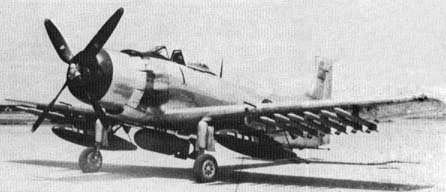
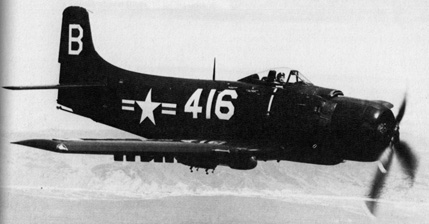
Douglas AD-1 Skyraider
BT2D (Skyraider prototype) Korean War-vintage Skyraider
The Skyraider was designed to be a replacement for the current naval torpedo/dive bombers that were then in use. It was felt that one aircraft could be designed that would able to fill both of these roles and more, and that reducing the crew to a single pilot would result in weight savings and speed increases, both factors that would enable the aircraft to carry more ordnance more effectively. Though a competing design (the Martin AM-1 Mauler) also attempted to fill the same design spec, the Skyraider was definitely the more successful of the two. However, it was not until the closing months of World War II that the prototype was flown for the first time, on March 18 1945. Although delivery of production aircraft began in June, the type was not used operationally before VJ-Day. After WWII the Skyraider was to become one of the most valuable weapons available to both U.S. Navy and USAF during the Korean and Vietnam wars (some bearing the designation A-1, and the affectionate nickname "Sandy"). In Korea the Skyraider's contribution was sufficient to win a US Navy accolade of "the best and most effective close support airplane in the world"'. Skyraiders remained in production until February 1957, by which time 3,160 had been built.
Type: carrier-based attack aircraft Crew: 1 Armament: two 20mm cannon up to 6000 lbs. of mixed weapons externally Specifications: Length: 38' 2" (11.63 m) Height: 15' 5" (4.70 m) Wingspan: 50' 0" (15.24 m) Wing area: 400 sq. ft (37.16 sq. m) Empty Weight: 10,264 lb (4656 kg) Max Weight: 18,030 lb (8178 kg) max at takeoff Propulsion: No. of Engines: 1 Powerplant: Wright R-3350-24 Cyclone 18 radial Horsepower: 2400 hp Performance: Range: 1900 miles (3058 km) Cruise Speed: 204 mph ( 328 km/h) Max Speed: 366 mph ( 589 km/h) at 13,500 ft Ceiling: 33,000 ft (10,060 m)
Martin AM-1 Mauler
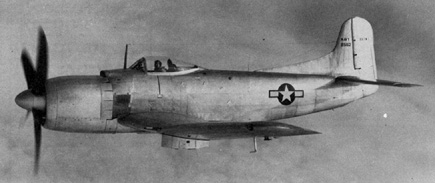
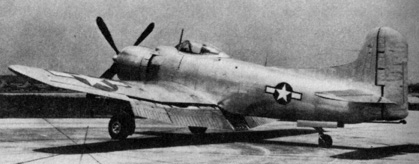
In 1943 the U.S. Navy began to plan for a new type of attack aircraft, one
that would combine the roles of the scout and torpedo bombers (such as the Curtiss Helldiver and the Grumman Avenger).
These plans drew on the experience of two  years of active carrier operations and would reflect the changing demands of
naval air power. The emphasis was to be on load-carrying capability and
performance, using a single-seat airframe designed around the most powerful
engine then available. The offensive load was to be placed on external
hardpoints (instead of internal weapon bays), which would save in both airframe
weight and complexity. Martin aircraft submitted a design proposal known as the
Model 210, which was given the Navy designation XBTM-1. The first prototype flew
in August 1944, with a production order for 750 BTM-1s following in January
1945. The designation was changed to AM-1 and the aircraft was given the name
the Mauler. The first production aircraft did not fly until December 1946, with
deliveries to an active Navy squadron starting in March 1948. Only 149 Maulers
were completed before production ceased in October 1949, and most of these were
passed the Navy Reserve squadrons. The Navy had instead decided to use the Douglas AD-1 Skyraider, which became the
standard U.S. Navy attack aircraft, serving with distinction in Korea and
Vietnam.
Type:		single-seat carrier-based attack aircraft
Crew:		1
Armament:	four 20mm cannon
		up to 4,500 lb. of bombs and/or rockets

Specifications:
	Length:        	41' 2" (12.55 m)
	Height:        	16' 10 (5.13 m)
	Wingspan:      	50' 0" (15.24 m)
	Wing area:	496 sq. ft (46.08 sq. m)
	Empty Weight:  	14,500 lb (6577 kg)
	Max Weight: 	23,386 lb (10,608 kg) max at takeoff

Propulsion:
	No. of Engines:	1
	Powerplant:    	Pratt & Whitney R-4360-4W 28-cylinder radial
				Note: some sources list the engine as a
				2975 hp	Wright R-3350-4 Cyclone 18 radial
	Horsepower:	N/A,
Performance: Range: 1800 miles (2897 km) Cruise Speed: 189 mph ( 304 km/h) Max Speed: 367 mph ( 591 km/h) at 11,600 ft Ceiling: 30,500 ft (9295 m)
Curtiss BT2C
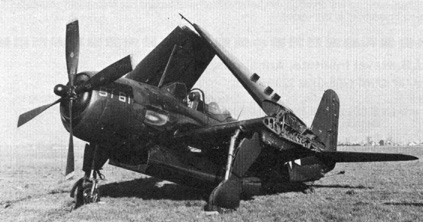 When the Navy released the specifications for a new carrier-based
attack aircraft, four companies were selected to develop prototypes for
the project. This new aircraft was to take the place of the mixture of
dive bombers and torpedo bombers currently serving in the fleet, by
combining the duties of both in a single design. This new aircraft was
also to carry a heavier amount of ordnance than its predecessors. The
four competitors were the Douglas XBT2D1 Dauntless II (later to be
known as the A-1 SkyRaider), the Martin XBTM-1 (later to become the AM-1 Mauler),
the Kaiser/Fleetwings XBTK-1, and the Curtiss XBTC. Work on the XBTC
was begun on December 31, 1943. After testing, the Navy choose to
pursue the Douglas and Martin designs exclusively. Not giving up,
Curtiss began work on an improved design known as the XBT2C-1, and in
March 1945 the Navy awarded Curtiss a contract for ten copies of this
new aircraft. It was powered by the same engine as the Skyraider, but
unlike the Douglas design, it was a two-place aircraft. The first
flight of a BT2C was made in January 1946, but only nine aircraft were
completed before development was abandoned. With this failure came the
end of Curtiss-Wright's aircraft manufacturing for the Navy, a
relationship that had endured since 1911.Type: carrier-based attack aircraft Crew: 2 Armament: guns: unknown also, a variety of ordnance carried on extra hardpoints and in an internal bomb bay Specifications: (info not available) Propulsion: No. of Engines: 1 Powerplant: Wright R-3350-24 Cyclone 18 radial Horsepower: 2400 hp Performance: (info not available)
Brewster XA-32
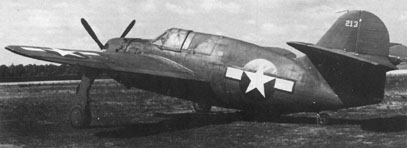
The XA-32 was a Brewster-designed attack aircraft, a mid-wing type with an internal bomb bay. The prototype had the R-2800 engine, but it could take the R-4360. It did not enter production. The problems in experimental aircraft were sometimes the result of problems inherent in the manufacturing company. Brewster had startled the world when its pudgy Buffalo beat out Grumman's entry in the first Navy monoplane fighter competition. After that, it scarcely did anything right; and the XA-32, despite a sound layout, became a compendium of management-induced faults. A husky brute of an attack plane, the XA-32 was terribly overweight at almost 20,000 pounds. The drag induced by its rotund shape was amplified by careless detail design, which left it festooned with bumps and lumps. It was underpowered by the Pratt and Whitney R-2800. The real problem, however, was that the XA-32 suffered from the terminally bad Brewster management system. First flight was not until 22 May 1943, two years after the design was proposed; and almost every aspect of performance fell short of the specifications. The firm was in such management shambles that it drew the wrath of Congress and actually went out of the aircraft manufacturing business. Only two examples built.
Type:		Attack dive-bomber
Crew:		2: Pilot, gunner
Armament: 	Four 20mm cannons
		Six 50-caliber machine guns in wings
		3000 lb. bombload that could include a torpedo

Specifications:
	Length:        	40' 7"
	Height:        	N/A
	Wingspan:      	45' 1"
	Wing area:	544 sq. feet
	Empty Weight:  	N/A
	Max Weight: 	N/A

Propulsion:
	No. of Engines:	1
	Powerplant:    	Pratt & Whitney R-2800
	Horsepower:	2100 to 2500 hp

Performance:
	Range:		500 miles with full load
	Cruise Speed:   N/A
	Max Speed:      311 mph
	Ceiling:       	N/A
Beechcraft XA-38 Grizzly
In 1942 Beech Aircraft had already started work on the design of a "bomber destroyer" aircraft, when the Army expressed an interest in developing a similar concept as a potent ground attack aircraft (as a replacement for the Douglas A-20 Havoc), to attack tanks, bunkers, and other hard-to-kill targets. The Beech design was already known as the Beechcraft Model 28 and had been given the name "Destroyer". In December 1942 the Army awarded Beech a contract to build two prototypes, under the designation XA-38. The name was changed to "Grizzly" soon after construction was begun. The Grizzly packed a formidable punch, with a 75mm cannon (with 20 rounds of ammo) sticking out of its stream-lined nose, as well as two nose-mounted .50 caliber machineguns, and a pair of .50s in each of the remotely controlled ventral and dorsal turrets. These turrets were controlled by a gunner using periscopic sights (similar to those used on the B-29) from the glassed-in observer's station in the aft fuselage. First flight of the initial prototype took place on May 7, 1944. Performance tests by the Army Air Corps were held through 1944 and 1945, with the results being as good or better than expected in most respects, including speed. There is even a story that the Grizzly "ran away" from a P-51B Mustang that was being used as a chase plane. Gunnery tests proved the effectiveness of the heavy armament, and serviceability was praised as well. Had the war continued it is probable that - with its speed, firepower, and rugged construction - the A-38 would have become the Army Air Force's most important attack bomber. However, by this time it was 1945, and it was becoming obvious that, not only was the war coming to an end, but so was the day of the piston engine. In addition to this, the engines for the Grizzly were the same as those used in the B-29, and the few engines that were not slated for that bomber were usually given to the new Douglas BT2D-1 aircraft program. The program ended with only the two prototypes being built, with one being scrapped in the forties, and the other being slated for display in the Air Force Museum, but disappearing, never to be seen again. The Grizzly remains a minor footnote in U.S. aviation history, as well as one of the most tantalizing "might-have-beens" of the war.
Type:		bomber interceptor / ground attack
Crew:		2, pilot and gunner
Armament:	one T15E1 75mm cannon (w/ 20 rounds)
                six .50 caliber machine guns (two in the
                lower forward fuselage, 2 each in the
                ventral and dorsal remotely controlled
                turrets)
                up to 2,000 lb of external stores

Specifications:
	Length:        	51' 9"
	Height:        	13' 6"
	Wingspan:      	67' 4"
	Wing area:	626 sq. ft
	Empty Weight:  	22,480 lb
	Max Weight: 	32,000 lb max at takeoff

Propulsion:
	No. of Engines:	2
	Powerplant:    	Wright R-3350-53 radial
	Horsepower:	2700 hp each

Performance:
	Range:		1070 miles (with 2000 lb. load)
	Cruise Speed:   344 mph
	Max Speed:      376 mph at 4,800 feet
	Ceiling:       	27,800 ft
