Trainers
North American AT-6/SNJ Texan
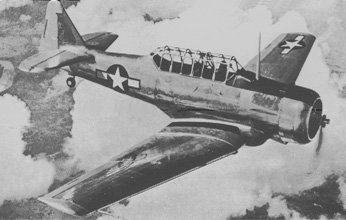
North American developed a fabric-covered two-seat trainer known as the BT-9, which led to an metal-skinned version designated the BT-14, and a related type known as the NA-26. The BT-14 was a fixed landing gear aircraft was developed into a more refined version with retractable gear, designated the AT-6. Known as the AT-6 Texan to the USAAF, as the SNJ to the U.S. Navy, and as the Harvard to the Commonwealth air forces, the T-6 was the most universally used military training aircraft of all time. More than 17,000 examples of a number of versions were built, a number of which still fly today. Most all of the U.S. pilots in World War II flew this aircraft at one time in their career.
Type:           two-seat advanced trainer
Crew:           2: Pilot, trainee
Armament:       none (though some foriegn versions were
                    armed for close air support roles.

Specifications:
        Length:         29.6' 3" (8.99 m)
        Height:         11' 9" (3.58 m)
        Wing span:      42.25' (12.8 m)
        Wing area:      253.7  sq. ft (23.57 sq. m)
        Empty Weight:   4158 lbs (1886 kg)
        Takeoff Weight: 5300 lbs (2404 kg) maximum

Propulsion:
        No. of Engines: 1
        Powerplant:     Pratt & Whitney R-1340-AN-1 Wasp
        Horsepower:     550 hp

Performance:
        Range:          750 miles (1207 km)
        Cruise Speed:   170 mph (274 km/hr)
        Max Speed:      205 mph (330 km/hr)
        Ceiling:        21,500 ft (6555 m)
Beechcraft AT-7 Navigator/AT-11 Kansan
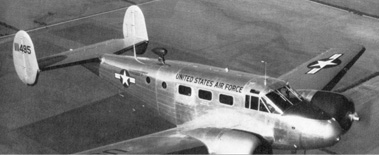
The USAAC first ordered this type of aircraft in 1940 under the designation C-45, for use as a staff transport. These aircraft were re-designated UC-45s in 1943. Other variants included the AT-7 Navigator, introduced in 1941 for navigator training. This had a dorsal astrodome and positions for three trainees. Some 577 of these were built. 1941 also saw the introduction of the AT-11 Kansan, which was a bombing/gunnery trainer. Production of the AT-11 totaled 1,582, and included 36 examples completed as the AT-11A navigation trainer. Another Model 18 variant was the F-2 photo-reconnaissance model, of which 69 examples were acquired. The U.S. Navy and Marine Corps also procurred the Model 18, with a total of over 1,500 examples. The JRB-1 was the equivalent of the F-2, the JRB-2 was a transport, and the JRB-3 and -4 were the equivalent of the UC-45. The SNB-1, -2, & -3 were the equivalents of the AT-11, -7, and -7C, respectively. The F-2 was yet another variant of the Model 18 that was built to carry two to four aerial cameras and used for reconnaissance and aerial mapping. Only about 70 of the F-2 models were built. Other variants of the Model 18 included an air ambulance and a electronics countermeasure trainer.
Type: navigation and bombing trainer
Crew: ?, plus 3 trainees
Armament: none
Specifications:
Length: 34' 2" (10.41 m)
Height: 9' 8" (2.95 m)
Wingspan: 47' 8" (14.53 m)
Wing area: 349 sq. ft (32.42 sq. m)
Empty Weight: 6175 lb (2801 kg)
Max Weight: 8727 lb (3959 kg) max at takeoff
Propulsion:
No. of Engines: 2
Powerplant: Pratt & Whitney R-985-AN-1 radial
Horsepower: 450 hp
Performance:
Range: 850 miles (1368 km)
Cruise Speed: (not listed)
Max Speed: 215 mph ( 346 km/h)
Ceiling: 20000 ft (6095 m)
Curtiss AT-9 Jeep
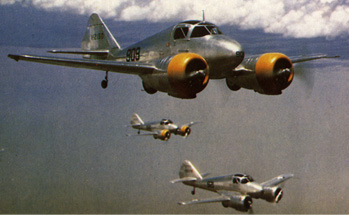
The AT-9 was developed by Curtiss as a training aircraft that would aid in a trainee's transition to a a high performance twin-engined bomber. Known initially as the Model 25, the aircraft was ordered into production as the AT-9. 491 examples were built for the USAAC, with 300 more examples of the generally similar AT-9A also being produced. They remained in use for a comparatively short time, for with the U.S. entry in the war in late 1941, far more effective training aircraft were soon developed.
Type:		advanced trainer
Crew:		2
Armament:	none

Specifications:
	Length:        	31' 8" (9.65 m)
	Height:        	9' 10" (2.99 m)
	Wingspan:      	40' 4" (12.99 m)
	Wing area:	233 sq. ft (21.65 sq. m)
	Empty Weight:  	4600 lb (2087 kg)
	Max Weight: 	6000 lb (2722 kg) max at takeoff

Propulsion:
	No. of Engines:	2
	Powerplant:    	Lycoming R-680-9 radial
	Horsepower:	295 hp each

Performance:
	Range:		750 miles (1207 km)
	Cruise Speed:   175 mph ( 282 km/h)
	Max Speed:      197 mph ( 317 km/h)
	Ceiling:       	(not listed)
Beechcraft AT-10 Wichita
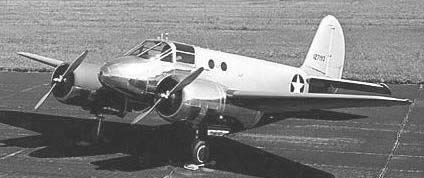
The Beech Aircraft Corporation’s Model 18 was a successful design that was used in a various configurations, such as the AT-7 and the AT-11. A less well known variant of the twin Beech design was the AT-10 Wichita, which was a version of the AT-7 constructed mostly of wood and using lighter and less powerful engines. The design resulted from the fear that supplies of some strategic light metals could be halted by the war, so aircraft may need to have been built from natural supplies. Initially referred to as the Beech Model 26, the AT-10 was given the nickname Wichita, and used as an advanced trainer. Beech Aircraft built 1,771 AT-10s during the war, with Globe Aircraft Corporation producing another 600 examples. Final deliveries were made on September 15, 1943.
Type: Advanced Trainer
Crew: 2
Armament: none
Specifications:
Length: 34' 4" (10.46 m)
Height: n/a
Wingspan: 44' 0" (13.41 m)
Wing area: 298 sq. ft. (27.68 sq. m)
Empty Weight: 4750 lb. (2155 kg)
Max Weight: 6130 lb. (2781 kg)
Propulsion:
No. of Engines: 2
Powerplant: Lycoming R-680-9 radial engines
Horsepower: 295 hp
Performance:
Range: 770 miles (1239 km)
Cruise Speed: n/a
Max Speed: 198 mph (319 km/h)
Ceiling: 16,900 ft. (5150m)
Cessna Model AT-17/T-50/UC-78 Bobcat
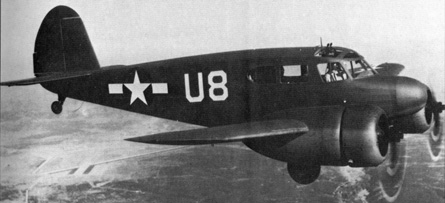
Cessna's first twin-engined lightplane, built and flown in 1939, was
a five-seat commercial transport that was typical for its day. Designated the
T-50 by Cessna, the aircraft caught the attention of both the Canadian and U.S.
Air Forces (USAAC then), with the potential to serve as a trainer for pilots
converting from single-engined to twin-engined types. 550 were supplied to
Canada (as the Crane 1A) under Lend-Lease, and 33 examples were ordered by the
USAAC for service evaluation. The initial production version for the U.S. was
designated the AT-17, and approximately 1149 examples were made in several
versions. 1287 additional aircraft were ordered in a liason/communication and
light personnel version, this being designated the UC-78 Bobcat. Over 2400
UC-78s were made in various versions. In 1942-43 the U.S. Navy also procurred 67
UC-78s for their own use, and these were designated JRC-1s.
Type: trainer/light transport
Crew: 2-5
Armament: none
Specifications:
Length: 32' 9" (9.98 m)
Height: 9' 11" (3.02 m)
Wingspan: 41' 11" (12.78 m)
Wing area: 295 sq. ft (27.41 sq. m)
Empty Weight: 3500 lb (1588 kg)
Max Weight: 5700 lb (2585 kg) max at takeoff
Propulsion:
No. of Engines: 2
Powerplant: Jacobs R-775-9 radial
Horsepower: 245 hp each
Performance:
Range: 750 miles (1207 km)
Cruise Speed: 175 mph ( 282 km/h)
Max Speed: 195 mph ( 314 km/h)
Ceiling: 22,000 ft (6705 m)
Lockheed A-28/A-29 Hudson
also: AT-18,
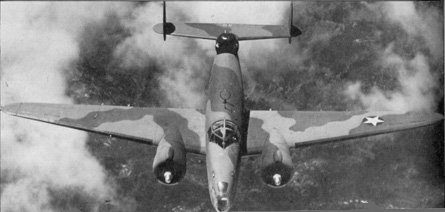
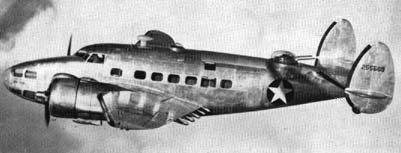
The Lockheed Hudson was the first American aircraft to be used operationally
by the RAF during World War II. It was designed to meet a British requirement
for a martime patrol/navigational trainer aircraft. The first 200 aircraft
arrived in England in February 1939, with about 1500 total procured before
introduction of the Lend-Lease program. In USAAF service the various versions
served as troop transports, bomber crew trainers, photo-reconnaissance aircraft,
anti-submarine patrol aircraft, trainers for air gunners, and as a target tug.
Twenty examples were used by the U.S. Navy as maritime patrol aircraft under the
designation PBO-1. The Lockheed AT-18 was an advanced trainer based on the
Lockheed Hudson. The USAAF placed an order for 300 AT-18s on 8 May 1942. 217
aircraft were produced as AT-18-LO gunnery trainers, equipped with a Martin
dorsal turret armed with twin 0.50in machine guns, while the remaining 83
aircraft were produced as AT-18A-LO navigational trainers. These aircraft had
the turret removed and had space for the pilot, the instructor and three
students. In all, over 2500 Hudsons were built, and many remained in service in
a secondary role until the end of the war.
Type: maritime patrol bomber/Trainer
Crew: ?
Armament: five 0.30 inch machine guns
up to 1,600 lbs. of bombs
Specifications:
Length: 44' 4" (13.51 m)
Height: 11' 11" (3.63 m)
Wingspan: 65' 6" (19.96 m)
Wing area: 551 sq. ft (51.19 sq. m)
Empty Weight: 12,825 lb (5817 kg)
Max Weight: 20,500 lb (9299 kg) max at takeoff
Propulsion:
No. of Engines: 2
Powerplant: Wright R-1820-87 Cyclone 9 radial
Horsepower: 1200 hp each
Performance:
Range: 1550 miles (2494 km)
Cruise Speed: 205 mph ( 330 km/h)
Max Speed: 253 mph ( 407 km/h) at 15,000 ft
Ceiling: 26,500 ft (8075 m)
Stinson Reliant / UC-81
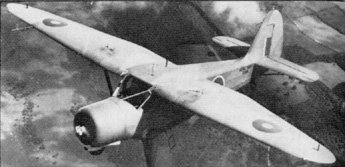
The Stinson Reliant was designed as a civilian aircraft
in the 1930s, with eight different versions available by 1939. Production of the
Reliant ceased on the USA's entry into the war, but a number of civil machines
were impressed into military service, where they received the designation UC-81.
Production was resumed on the Reliant for the purpose of providing the British
with 500 examples for the Royal Navy under Lend-Lease
agreements.
Type: navigation/radio trainer/communications a/c
Crew: 4
Armament: none
Specifications:
Length: 30' 0" (9.14 m)
Height: 8' 7" (2.62 m)
Wingspan: 41' 10.5" (12.76 m)
Wing area: 258.5 sq. ft (24.01 sq. m)
Empty Weight: 2810 lb (1275 kg)
Max Weight: 4000 lb (1814 kg) max at takeoff
Propulsion:
No. of Engines: 1
Powerplant: Lycoming R-680 radial
Horsepower: 290 hp
Performance:
Range: 810 miles (1313 km)
Cruise Speed: 130 mph ( 209 km/h)
Max Speed: 141 mph ( 227 km/h)
Ceiling: 14,000 ft (4265 m)
Fairchild AT-21 Gunner
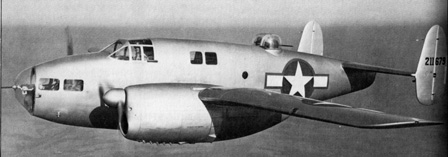
The AT-21 Gunner was designed to fill the need for a way to train
bomber aircrews, especially in regards to the operation of a bomber's machine
gun defenses. In this way trainees could learn how to use a power turret or a
gun on a flex mount, as well as learn to function as a member of a crew. 175
AT-21s were produced (some were manufactured by Bellanca, and some by McDonnell,
but most were made by Fairchild), and they remained in service until 1944, when
they were replaced by training examples of the actual aircraft in which the
gunners would eventually serve.
Type: specialized gunnery trainer
Crew: 4
Armament: one .30 cal machine gun in nose
two .30 cal machine guns in dorsal turret
Specifications:
Length: 38' 0" (11.58 m)
Height: 13' 1.5" (4.00 m)
Wingspan: 52' 8" (16.05 m)
Wing area: 378 sq. ft (35.12 sq. m)
Empty Weight: 8654 lb (3925 kg)
Max Weight: 11,288 lb (5120 kg) max at takeoff
Propulsion:
No. of Engines: 2
Powerplant: Ranger V-750-15 inline
Horsepower: 520 hp each
Performance:
Range: 910 miles (1464 km)
Cruise Speed: 196 mph ( 315 km/h) at 12,000 ft
Max Speed: 225 mph ( 362 km/h) at 12,000 ft
Ceiling: 22,150 ft (6750 m)
Fleetwings BT-12
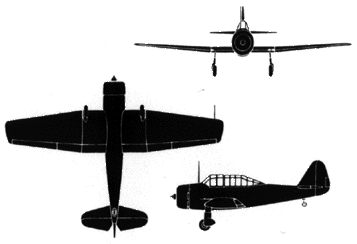
At the beginning of WWII the U.S. found itself badly in need of aircraft, especially training aircraft. The company of Fleetwings, Inc. was given the task of building a basic trainer for the USAAF under the designation BT-12. It was a conventional low-wing monoplane with fixed gear and dual fully-functional cockpits. The unconventional feature of the BT-12 lay in its construction, which in large part was of stainless steel (not aluminum). Fabrication was almost entirely of spot or seam welding. In addition to the initial prototype, 24 examples were produced and delivered during 1942-43.
The USAAC first ordered this type of aircraft in 1940 under the designation C-45, for use as a staff transport. These aircraft were re-designated UC-45s in 1943. Other variants included the AT-7 Navigator, introduced in 1941 for navigator training. This had a dorsal astrodome and positions for three trainees. Some 577 of these were built. 1941 also saw the introduction of the AT-11 Kansan, which was a bombing/gunnery trainer. Production of the AT-11 totaled 1,582, and included 36 examples completed as the AT-11A navigation trainer. Another Model 18 variant was the F-2 photo-reconnaissance model, of which 69 examples were acquired. The U.S. Navy and Marine Corps also procurred the Model 18, with a total of over 1,500 examples. The JRB-1 was the equivalent of the F-2, the JRB-2 was a transport, and the JRB-3 and -4 were the equivalent of the UC-45. The SNB-1, -2, & -3 were the equivalents of the AT-11, -7, and -7C, respectively. The F-2 was yet another variant of the Model 18 that was built to carry two to four aerial cameras and used for reconnaissance and aerial mapping. Only about 70 of the F-2 models were built. Other variants of the Model 18 included an air ambulance and a electronics countermeasure trainer.
Type: navigation and bombing trainer
Crew: ?, plus 3 trainees
Armament: none
Specifications:
Length: 34' 2" (10.41 m)
Height: 9' 8" (2.95 m)
Wingspan: 47' 8" (14.53 m)
Wing area: 349 sq. ft (32.42 sq. m)
Empty Weight: 6175 lb (2801 kg)
Max Weight: 8727 lb (3959 kg) max at takeoff
Propulsion:
No. of Engines: 2
Powerplant: Pratt & Whitney R-985-AN-1 radial
Horsepower: 450 hp
Performance:
Range: 850 miles (1368 km)
Cruise Speed: (not listed)
Max Speed: 215 mph ( 346 km/h)
Ceiling: 20000 ft (6095 m)
Curtiss AT-9 Jeep
The AT-9 was developed by Curtiss as a training aircraft that would aid in a trainee's transition to a a high performance twin-engined bomber. Known initially as the Model 25, the aircraft was ordered into production as the AT-9. 491 examples were built for the USAAC, with 300 more examples of the generally similar AT-9A also being produced. They remained in use for a comparatively short time, for with the U.S. entry in the war in late 1941, far more effective training aircraft were soon developed.Type: advanced trainer Crew: 2 Armament: none Specifications: Length: 31' 8" (9.65 m) Height: 9' 10" (2.99 m) Wingspan: 40' 4" (12.99 m) Wing area: 233 sq. ft (21.65 sq. m) Empty Weight: 4600 lb (2087 kg) Max Weight: 6000 lb (2722 kg) max at takeoff Propulsion: No. of Engines: 2 Powerplant: Lycoming R-680-9 radial Horsepower: 295 hp each Performance: Range: 750 miles (1207 km) Cruise Speed: 175 mph ( 282 km/h) Max Speed: 197 mph ( 317 km/h) Ceiling: (not listed)
Beechcraft AT-10 Wichita
The Beech Aircraft Corporation’s Model 18 was a successful design that was used in a various configurations, such as the AT-7 and the AT-11. A less well known variant of the twin Beech design was the AT-10 Wichita, which was a version of the AT-7 constructed mostly of wood and using lighter and less powerful engines. The design resulted from the fear that supplies of some strategic light metals could be halted by the war, so aircraft may need to have been built from natural supplies. Initially referred to as the Beech Model 26, the AT-10 was given the nickname Wichita, and used as an advanced trainer. Beech Aircraft built 1,771 AT-10s during the war, with Globe Aircraft Corporation producing another 600 examples. Final deliveries were made on September 15, 1943.
Type: Advanced Trainer Crew: 2 Armament: none Specifications: Length: 34' 4" (10.46 m) Height: n/a Wingspan: 44' 0" (13.41 m) Wing area: 298 sq. ft. (27.68 sq. m) Empty Weight: 4750 lb. (2155 kg) Max Weight: 6130 lb. (2781 kg) Propulsion: No. of Engines: 2 Powerplant: Lycoming R-680-9 radial engines Horsepower: 295 hp Performance: Range: 770 miles (1239 km) Cruise Speed: n/a Max Speed: 198 mph (319 km/h) Ceiling: 16,900 ft. (5150m)
Cessna Model AT-17/T-50/UC-78 Bobcat
Cessna's first twin-engined lightplane, built and flown in 1939, was a five-seat commercial transport that was typical for its day. Designated the T-50 by Cessna, the aircraft caught the attention of both the Canadian and U.S. Air Forces (USAAC then), with the potential to serve as a trainer for pilots converting from single-engined to twin-engined types. 550 were supplied to Canada (as the Crane 1A) under Lend-Lease, and 33 examples were ordered by the USAAC for service evaluation. The initial production version for the U.S. was designated the AT-17, and approximately 1149 examples were made in several versions. 1287 additional aircraft were ordered in a liason/communication and light personnel version, this being designated the UC-78 Bobcat. Over 2400 UC-78s were made in various versions. In 1942-43 the U.S. Navy also procurred 67 UC-78s for their own use, and these were designated JRC-1s.
Type: trainer/light transport Crew: 2-5 Armament: none Specifications: Length: 32' 9" (9.98 m) Height: 9' 11" (3.02 m) Wingspan: 41' 11" (12.78 m) Wing area: 295 sq. ft (27.41 sq. m) Empty Weight: 3500 lb (1588 kg) Max Weight: 5700 lb (2585 kg) max at takeoff Propulsion: No. of Engines: 2 Powerplant: Jacobs R-775-9 radial Horsepower: 245 hp each Performance: Range: 750 miles (1207 km) Cruise Speed: 175 mph ( 282 km/h) Max Speed: 195 mph ( 314 km/h) Ceiling: 22,000 ft (6705 m)
Lockheed A-28/A-29 Hudson
also: AT-18,
The Lockheed Hudson was the first American aircraft to be used operationally by the RAF during World War II. It was designed to meet a British requirement for a martime patrol/navigational trainer aircraft. The first 200 aircraft arrived in England in February 1939, with about 1500 total procured before introduction of the Lend-Lease program. In USAAF service the various versions served as troop transports, bomber crew trainers, photo-reconnaissance aircraft, anti-submarine patrol aircraft, trainers for air gunners, and as a target tug. Twenty examples were used by the U.S. Navy as maritime patrol aircraft under the designation PBO-1. The Lockheed AT-18 was an advanced trainer based on the Lockheed Hudson. The USAAF placed an order for 300 AT-18s on 8 May 1942. 217 aircraft were produced as AT-18-LO gunnery trainers, equipped with a Martin dorsal turret armed with twin 0.50in machine guns, while the remaining 83 aircraft were produced as AT-18A-LO navigational trainers. These aircraft had the turret removed and had space for the pilot, the instructor and three students. In all, over 2500 Hudsons were built, and many remained in service in a secondary role until the end of the war.
Type: maritime patrol bomber/Trainer Crew: ? Armament: five 0.30 inch machine guns up to 1,600 lbs. of bombs Specifications: Length: 44' 4" (13.51 m) Height: 11' 11" (3.63 m) Wingspan: 65' 6" (19.96 m) Wing area: 551 sq. ft (51.19 sq. m) Empty Weight: 12,825 lb (5817 kg) Max Weight: 20,500 lb (9299 kg) max at takeoff Propulsion: No. of Engines: 2 Powerplant: Wright R-1820-87 Cyclone 9 radial Horsepower: 1200 hp each Performance: Range: 1550 miles (2494 km) Cruise Speed: 205 mph ( 330 km/h) Max Speed: 253 mph ( 407 km/h) at 15,000 ft Ceiling: 26,500 ft (8075 m)Stinson Reliant / UC-81
The Stinson Reliant was designed as a civilian aircraft in the 1930s, with eight different versions available by 1939. Production of the Reliant ceased on the USA's entry into the war, but a number of civil machines were impressed into military service, where they received the designation UC-81. Production was resumed on the Reliant for the purpose of providing the British with 500 examples for the Royal Navy under Lend-Lease agreements.
Type: navigation/radio trainer/communications a/c Crew: 4 Armament: none Specifications: Length: 30' 0" (9.14 m) Height: 8' 7" (2.62 m) Wingspan: 41' 10.5" (12.76 m) Wing area: 258.5 sq. ft (24.01 sq. m) Empty Weight: 2810 lb (1275 kg) Max Weight: 4000 lb (1814 kg) max at takeoff Propulsion: No. of Engines: 1 Powerplant: Lycoming R-680 radial Horsepower: 290 hp Performance: Range: 810 miles (1313 km) Cruise Speed: 130 mph ( 209 km/h) Max Speed: 141 mph ( 227 km/h) Ceiling: 14,000 ft (4265 m)Fairchild AT-21 Gunner
The AT-21 Gunner was designed to fill the need for a way to train
bomber aircrews, especially in regards to the operation of a bomber's machine gun defenses. In this way trainees could learn how to use a power turret or a gun on a flex mount, as well as learn to function as a member of a crew. 175 AT-21s were produced (some were manufactured by Bellanca, and some by McDonnell, but most were made by Fairchild), and they remained in service until 1944, when they were replaced by training examples of the actual aircraft in which the gunners would eventually serve.
Type: specialized gunnery trainer Crew: 4 Armament: one .30 cal machine gun in nose two .30 cal machine guns in dorsal turret Specifications: Length: 38' 0" (11.58 m) Height: 13' 1.5" (4.00 m) Wingspan: 52' 8" (16.05 m) Wing area: 378 sq. ft (35.12 sq. m) Empty Weight: 8654 lb (3925 kg) Max Weight: 11,288 lb (5120 kg) max at takeoff Propulsion: No. of Engines: 2 Powerplant: Ranger V-750-15 inline Horsepower: 520 hp each Performance: Range: 910 miles (1464 km) Cruise Speed: 196 mph ( 315 km/h) at 12,000 ft Max Speed: 225 mph ( 362 km/h) at 12,000 ft Ceiling: 22,150 ft (6750 m)
Fleetwings BT-12
At the beginning of WWII the U.S. found itself badly in need of aircraft, especially training aircraft. The company of Fleetwings, Inc. was given the task of building a basic trainer for the USAAF under the designation BT-12. It was a conventional low-wing monoplane with fixed gear and dual fully-functional cockpits. The unconventional feature of the BT-12 lay in its construction, which in large part was of stainless steel (not aluminum). Fabrication was almost entirely of spot or seam welding. In addition to the initial prototype, 24 examples were produced and delivered during 1942-43.
Type: two-seat basic trainer
Crew: 2: pilot, trainee
Armament: none
Specifications:
Length: 29' 2" (8.89 m)
Height: 8' 8" (2.64 m)
Wingspan: 40' 0" (12.19 m)
Wing area: 240.4 sq. ft (23.33 sq. m)
Empty Weight: 3173 lb (1439 kg)
Max Weight: 4410 lb (2000 kg) max at takeoff
Propulsion (N3N-3):
No. of Engines: 1
Powerplant: Pratt & Whitney R-985-25 Junior Wasp radial
Horsepower: 450 hp
Performance:
Range: 550 miles (885 km)
Cruise Speed: 175 mph ( 282 km/h)
Max Speed: 195 mph ( 314 km/h)
Ceiling: 23,800 ft (7255 m)
Timm N2T Tutor
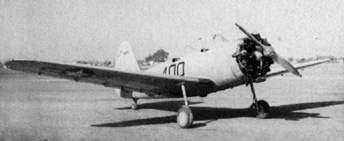
The Timm Aircraft Corporation introduced a method of aircraft construction that involved the use of a plastic-bonded plywood which they themselves had developed. In 1941 they designed a two-seat light aircraft using this material, which came to be known as the S-160-K. The U.S. military took an interest in the aircraft because it used non-conventional materials in its construction. The U.S. Navy tested two aircraft and eventually issued contracts for 260 models that were designated the N2T-1 Tutor. Deliveries of the N2T-1s began in 1943, and they remained in use as primary trainers until towards the end of 1944.
Type:		primary trainer
Crew:		2
Armament:	none

Specifications:
	Length:        	24' 10" (7.57 m)
	Height:        	10' 8" (3.25 m)
	Wingspan:      	36' 0" (10.97 m)
	Wing area:	185 sq. ft (17.19 sq. m)
	Empty Weight:  	1940 lb (880 kg)
	Max Weight: 	2725 lb (1236 kg) max at takeoff

Propulsion:
	No. of Engines:	1
	Powerplant:    	Continental R-670-4 radial
	Horsepower:	220 hp

Performance:
	Range:		400 miles (644 km)
	Cruise Speed:   124 mph ( 200 km/h)
	Max Speed:      144 mph ( 232 km/h)
	Ceiling:       	16,000 ft (4875 m)
Naval Aircraft Factory N3N Canary
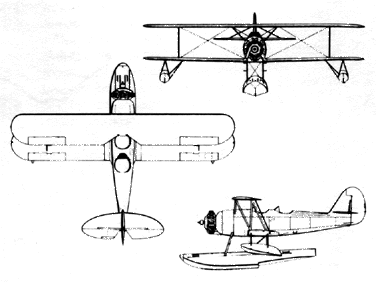
In 1934 the Naval Aircraft Factory was given the task of manufacturing a new primary trainer designed by the U.S. Navy. Following successful tests this neat little biplane trainer was built in both landplane and seaplane versions. 179 of the -1 models were ordered in the mid-Thirties, and production of 816 -3 models began in 1938. The N3N was used extensively in U.S. Navy primary flying training schools throughout WWII, with the majority becoming surplus immediately when the war ended. One exception to this was the small number of the seaplane version which were retained for primary training at the U.S. Naval Academy. These last N3N seaplanes, when retired in 1961, were the last biplanes to be used in U.S. military service. Type: two-seat primary trainer
Crew: 2: pilot, trainee
Armament: none
Specifications:
Length: 25' 6" (7.77 m)
Height: 10' 10" (3.30 m)
Wingspan: 34' 0" (10.36 m)
Wing area: 305 sq. ft (28.33 sq. m)
Empty Weight: 2090 lb (948 kg)
Max Weight: 2792 lb (1266 kg) max at takeoff
Propulsion (N3N-3):
No. of Engines: 1
Powerplant: Wright R-760-2 Whirlwind 7 radial
Horsepower: 235 hp
Performance:
Range: 470 miles (756 km)
Cruise Speed: 90 mph ( 145 km/h)
Max Speed: 126 mph ( 203 km/h)
Ceiling: 15,200 ft (4635 m)
Spartan NP-1
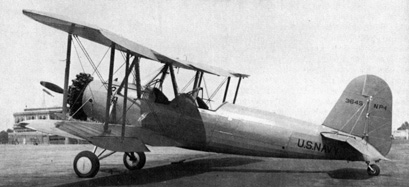
In early 1940 the U.S. Navy advised manufacturers of a requirement for two-seat primary trainer of biplane configuration. A proposal from the Spartan Aircraft Company, based on the company's 1927 open-cockpit biplane, was selected by the U.S. Navy. A contract for one prototype (XNP-1) and 200 later production aircraft was awarded. It was the first military aircraft to be produced by Spartan. The NP-1 was used to equip the newly established U.S. Naval Reserve primary flying training schools in Atlanta, Dallas, and New Orleans, where they continued to serve for many years.
Type:		primary trainer
Crew:		2
Armament:	none

Specifications:
	Length:        	24' 2.75" (7.39 m)
	Height:        	8' 4" (2.54 m)
	Wingspan:      	33' 8.5" (10.27 m)
	Wing area:	301.3 sq. ft (27.99 sq. m)
	Empty Weight:  	2069 lb (938 kg)
	Max Weight: 	2775 lb (1259 kg) max at takeoff

Propulsion:
	No. of Engines:	1
	Powerplant:    	Lycoming R-680-8 radial
	Horsepower:	220 hp

Performance:
	Range:		315 miles (507 km)
	Cruise Speed:   90 mph ( 145 km/h)
	Max Speed:      108 mph ( 174 km/h)
	Ceiling:       	13,200 ft (4025 m)
Boeing/Stearman Model 75/PT-13/N2S
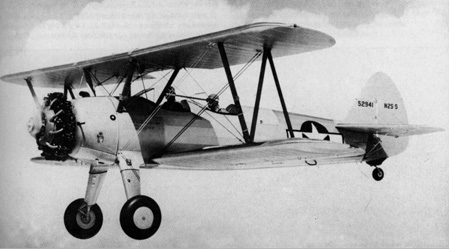
The Stearman Aircraft Company designed a new primary trainer for the U.S. Army Air Corps in 1933. It was, however, the U.S. Navy which was the first service to express an interest; and in 1935 ordered the first models under the designation NS-1; later Navy versions were known as the N2S. The USAAC began receiving theirs in 1936, under the designation PT-13. In 1939 Stearman became part of the Boeing Airplane Company. The Boeing/Stearman division produced modified later versions under the names PT-17, PT-18, and PT-27. The most common names for this aircraft remain the Model 75 Stearman, the PT-13 to the USAAC, and the N2S to the U.S. Navy. The unofficial nickname for the aircraft was the Kaydet. But whatever you called it, the stable and forgiving "Stearman" was an important part of American aviation primary training, and became a fond part of many U.S. aviator's memories. After the war many were sold as surplus, and large numbers became crop dusters. Quite a few survive today as privately-owned collector's items.
Type:           two-seat primary trainer
Crew:           2: pilot, trainee
Armament:       none

Specifications:
        Length:         25' 0.25" (7.63 m)
        Height:         9' 2" (2.79 m)
        Wingspan:       32' 2" (9.80 m)
        Wing area:      297 sq. ft (27.59 sq. m)
        Empty Weight:   1936 lb (878 kg)
        Max Weight:     2717 lb (1232 kg) max at takeoff

Propulsion:
        No. of Engines: 1
        Powerplant:     Lycoming R-680-17 radial
        Horsepower:     220 hp

Performance:
        Range:          505 miles (813 km)
        Cruise Speed:   106 mph ( 171 km/h)
        Max Speed:      124 mph ( 200 km/h)
        Ceiling:        11,200 ft (3415 m)
St. Louis PT-15
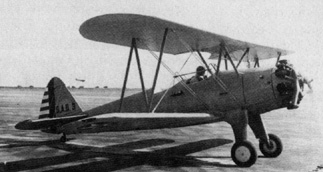
After being pared down in size during the non-war years following the First World War, the Army Air Corps found itself lacking great numbers of aircraft as the war clouds stirred again in 1939. Realizing that a new war would require training mass numbers of new pilots, the USAAC began to look for trainers of various types. During one of the many prototype competitiions for primary trainers that were held in 1939-1940, the St. Louis Model PT-1W biplane trainer (which had been built for the civilian market) was entered. The USAAC was soon interested in the design which, while not exactly as great a performer as hoped, was already currently available, and therefore could be obtained immediately. This was seen as preferable to waiting for a new design to be developed and tested. The St. Louis trainer was given the designation XPT-15, and a follow-up order was given for 13 YPT-15 pre-production aircraft. All of the trainers were delivered in 1940, and though used in the primary training role they were viewed as 'stop gaps' until aircraft procured to US Army specification became available, and no further orders ensued.
Type: primary trainer
Crew: 2
Armament: none
Specifications:
Length: 33' 1" (10.31 m)
Height: 15' 1" (4.61 m)
Wingspan: 35' 11" (10.95 m)
Wing area: 262 sq. ft (24.34 sq. m)
Empty Weight: 4123 lb (1870 kg)
Max Weight: 6000 lb (2722 kg) max at takeoff
Propulsion:
No. of Engines: 1
Powerplant: Pratt & Whitney R-985-AN-2 Wasp radial
Powerplant: Wright R-1860-52 Cyclone radial
Horsepower: 450 hp
Performance:
Range: 805 miles (1296 km)
Cruise Speed: 119 mph ( 292 km/h)
Max Speed: 164 mph ( 264 km/h) at 5500 ft
Ceiling: 13,000 ft (3960 m)
Ryan PT-16,PT-20,PT-21,PT-22 Recruit
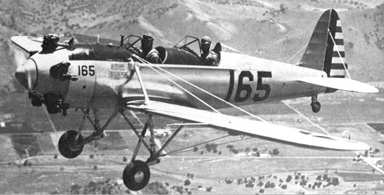
In 1934 Ryan Aircraft developed a training aircraft known as the S-T-A, and an example of this was delivered to the USAAC in 1939 under the designation XPT-16. This was the first primary training monoplane acquired by the USAAC; all previous types had been biplanes. 15 more PT-16s were acquired for testing, followed by a production order for 30 more in 1940, which were given the designation PT-20. The PT-20 was similar to the PT-16, with the exception of minor structural changes. During 1941 100 more examples were ordered with a more powerful engine, and were designated PT-21. The PT-21 was easily identified by its new streamlined nose fairing, through which the 5 engine cylinders protruded. Later in 1941 the need for trainers became more pressing, and 1,023 examples were ordered, this time under the designation PT-22 Recruit. The PT-22 was similar to the PT-21, but the PT-22 received a more powerful engine, and had the wheel spats and main landing gear fairings removed. The U.S. also used a version of the Recruit, when in 1940 they ordered 100 examples, to be designated the NR-1. The NR-1s remained in service until mid-1944.
Type:           two-seat primary trainer
Crew:           2
Armament:       none

Specifications:
        Length:         22' 5" (6.83 m)
        Height:         6' 10" (2.08 m)
        Wingspan:       30' 1" (9.17 m)
        Wing area:      134.25 sq. ft (12.47 sq. m)
        Empty Weight:   1313 lb (596 kg)
        Max Weight:     1860 lb (844 kg) max at takeoff

Propulsion:
        No. of Engines: 1
        Powerplant:     Kinner R-540-1 radial
        Horsepower:     160 hp

Performance:
        Range:          352 miles (566 km)
        Cruise Speed:   123 mph ( 198 km/h)
        Max Speed:      131 mph ( 211 km/h)
        Ceiling:        15,500 ft (4725 m)
Fairchild PT-19 Cornell
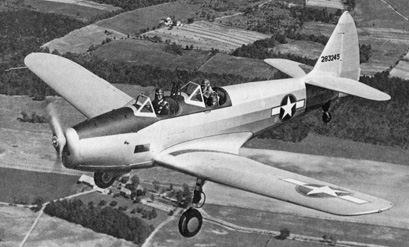
The PT-19 Cornell was designed to be a more advanced primary trainer, but had a wing-loading factor that was about 43% more than the PT-13.
In this way the PT-19 provided the USAAC pilots with a trainer that more like
the fighters they would eventually fly, rather than the older biplanes. Other
advantages were that the Cornell had instruments for blind-flying, and could
be fitted with a hood over the front cockpit for blind-flying training. 774
examples were built by Fairchild, with another 143 being built by Aeronca.
Type: two-seat primary trainer Crew: 2 Armament: none Specifications: Length: 27' 8.5" (8.45 m) Height: 7' 7.5" (2.97 m) Wingspan: 36' 0" (10.97 m) Wing area: 200 sq. ft (18.58 sq. m) Empty Weight: 2022 lb (917 kg) Max Weight: 2736 lb (1241 kg) max at takeoff Propulsion: No. of Engines: 1 Powerplant: Ranger L-440-C5 inline Horsepower: 200 hp Performance: Range: 400 miles (644 km) Cruise Speed: 101 mph ( 163 km/h) Max Speed: 122 mph ( 196 km/h) at 9000 ft Ceiling: 13,200 ft (4025 m)Curtiss SNC Falcon
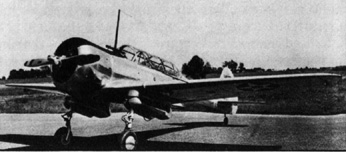 The SNC was developed from the CW-21 Demon to provide the U.S. Navy with an interim trainer.Type: advanced multi-role trainer Crew: 2 Armament: none Specifications: Length: 26' 6" (8.08 m) Height: 7' 6" (2.29 m) Wingspan: 35' 0" (10.67 m) Wing area: 174.3 sq. ft (16.19 sq. m) Empty Weight: 2610 lb (1184 kg) Max Weight: 3626 lb (1645 kg) max at takeoff Propulsion: No. of Engines: 1 Powerplant: Wright R-975-E3 Whirlwind 9 radial Horsepower: 420 hp Performance: Range: 515 miles (829 km) Cruise Speed: 195 mph ( 314 km/h) at 2500 ft Max Speed: 201 mph ( 323 km/h) Ceiling: 21,900 ft (6675 m)
Laister-Kauffman TG-4A
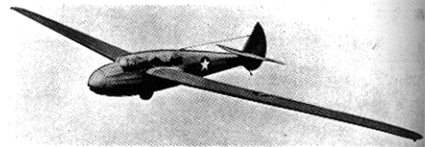
Laister-Kauffman was a company that built gliders for the civilian market, and when World War II broke out it was contracted by the U.S. Army to build three two-seat training gliders for evaluation purposes. Successful performance of these prototypes during testing led to a contract being awarded for 150 production TG-4As, and these were all delivered in 1942. Used quite extensively by the Army during the early stages of the war, all had however been declared surplus some time before VJ-Day.
Type: training glider Crew: two Armament: none Specifications: Length: 21' 3" (6.48 m) Height: 4' 0" (1.22 m) Wingspan: 50' 0" (15.24 m) Wing area: 166 sq ft. (15.42 m squared) Empty Weight: 475 lb (215 kg) Max Weight: 875 lb (397 kg) max at takeoff
