Curtiss-Wright CW-21 Demon
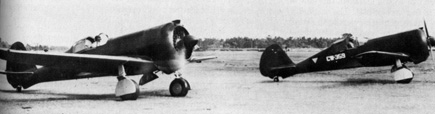
The Curtiss-Wright Model 21 (also known as the Curtiss-Wright Model 21 Demonstrator, the Curtiss-Wright CW-21 Interceptor, the Curtiss-Wright CW-21 Demon) was a United States built plane, developed by the St. Louis Airplane Division of Curtiss-Wright Corporation during the 1930s.The CW-21 Demon was a lightweight fighter based on the CW-19R general-purpose monoplane. It was intended primarily for export, with 32 being ordered by China in 1939, and 24 improved versions being ordered by the Netherlands East Indies in 1940. Being inadequately armed and with no worthwhile protection for the pilot, the Demons were fair game for the Japanese fighters they opposed. Three of the improved Demons (the CW-21B) were sent to the American Volunteer Group in China (the "Flying Tigers"), but all three were lost on the ferry flight from Rangoon to Kunming, when the entire group crashed into a mountain during bad weather.
	Type:			Fighter
	Crew:			1, Pilot
	Armament: 		two .30 cal machine guns, two .50 cal machine guns

	Specifications:
		Length:        	27' 2" (8.28 m)
		Height:        	8' 11' (2.72 m)
		Wingspan:      	35' 0" (10.67 m)
		Wing area:	174.3 sq. ft (16.19 sq. m)
		Empty Weight:  	3382 lb (1534 kg)
		Max Weight: 	4500 lb (2041 kg)

	Propulsion:
		No. of Engines:	1
		Powerplant:    	Wright R-1820-G5 Radial
		Horsepower:	1000 hp

	Performance:
		Range:		630 miles (1014 km)
		Cruise Speed:            282 mph ( 454 km/h)
		Max Speed:               315 mph ( 507 km/h)
		Ceiling:       	34,300 ft (10,455 m)
Brewster F2A Buffalo
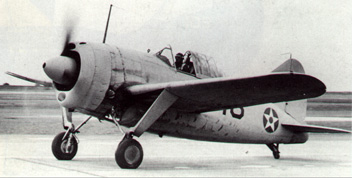
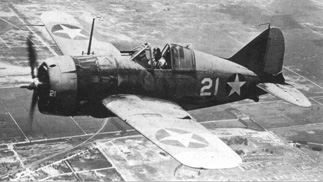
The Brewster F2A Buffalo was an American fighter plane which saw service in early World War II. It was designed and built by the Brewster Aeronautical Corporation, and was one of the first U.S. monoplanes with an stopping hook and other aircraft carrier modifications. The Buffalo won a competition against the Grumman F4F Wildcat in 1939 to become the U.S. Navy's first monoplane fighter aircraft. Although better than the Grumman F3F biplane and early Wildcats the Buffalo turned out to be a disappointment.The Buffalo is known for its portly barrel shape, and the heavy weight of added equipment was not balanced by an increase in horsepower making it a sluggish and slow performance aircraft. The only major action in U.S. hands was at the battle of Midway, where its Marine pilots suffered heavy casualties against the more nimble Japanese Zeros. Afterwards, Buffalos were replaced by F4F Wildcats, and were moved out to second-line duties.
	Type:                		Fighter
	Crew:               		1, Pilot
	Armament:       		four .50 cal machine guns

	Specifications:
       		 Length:               	26' 4" (83 m)
       		 Height:               	12' 0" (3.66 m)
       		 Wignspan:          	35' 0" (10.67 m)
      		 Wingarea:          	209  sq. ft (19.41 sq. m)
        		 Empty Weight:   	4732 lbs (2146 kg)
        		 Max Weight:    	7159 lbs (3246 kg)

	Propulsion:
      		 No. of Engines:  	1
       		 Powerplant:        	Wright R-1820-40
       		 Horsepower:      	1200 hp

	Performance:
       		Range:                	965 miles (1553 km)
       		Cruise Speed:     	161 mph (259 km/hr)
       		Max Speed:         	321 mph (516 km/hr)
        		Ceiling:                	33200 ft (10119 m)
Vought F4U Corsair
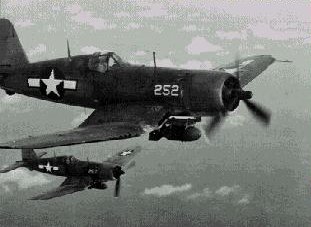
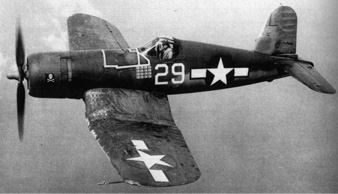
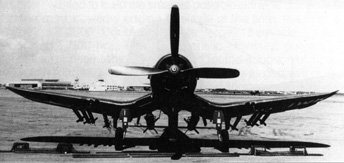
Known as the most outstanding carrier-based fighter to be used operationally in WWII, the Corsair has become legendary. Known to the Japanese as "Whistling Death", the Corsair was famous for its bent gull-wings and its high kill ratios. The Corsair was the first U.S. single-engined fighter to exceed 400 m.p.h., and had much better performance than the F4F Wildcat, which was the current top-of-the-line Navy fighter when the Corsair was introduced. Unfortunately, due to its very long nose (which limited pilot visibility, especially during take-offs and landings), the Navy high command believed them to be unsuitable for carrier operations. Typically, when the Navy had an aircraft that it did not want, it gave them to the Marines. This is what happened to the Corsairs, as they were restricted to land bases. The Marines were happy to replace their old Wildcats with this promising new fighter, and soon showed everyone what the Corsair was capable of. Pappy Boyington and his Black Sheep Squadron was one of many who used the Corsair's abilities to its fullest scoring 203 damaged Japanese planes in 84 days. Later in the war it was proven that the Corsairs could operate safely off of carriers, and they were used very successfully in helping to rid the kamikaze raids in the war's final months. Demand for the Corsairs were so high that Brewster and Goodyear helped produce some in the later years.
	Type:                		Fighter
	Crew:               		1, Pilot
	Armament:       		six .50 cal machine guns

	Specifications:
       		 Length:              	33' 8" (10.26 m)
       		 Height:              	14' 9" (4.50 m)
       		 Wingspan:         	41' (12.5 m)
       		 Empty Weight:   	9205 lbs (4174 kg)
        		 Max Weight:       	14670 lbs (6653 kg)

 	Propulsion:
        		No. of Engines:   	1
        		Powerplant:         	Pratt & Whitney R-2800-18W
       		Horsepower         	2100 hp

 	Performance:
       		 Range:               	1005 miles (1618 km)
       		 Max Speed:       	446 mph (718 km/hr)
       		 Ceiling:              	41500 ft (12649 m)
Grumman F4F Wildcat
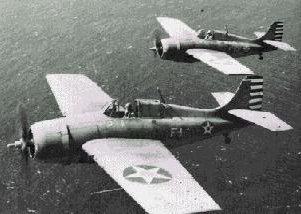
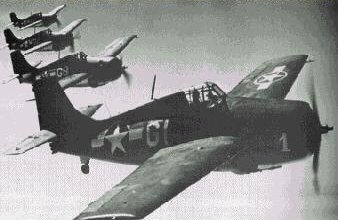
The Grumman F4F Wildcat was an American carrier based fighter plane built by General Motors. It began service with both the U.S. and British Navy in 1940. First used in combat by the British in Europe, the Wildcat was the only effective fighter available to the United States Navy and Marine Corps in the Pacific Theater during the early part of WWII in 1941 and 1942; the disappointing Brewster Buffalo was withdrawn in favor of the F4F Wildcat and replaced.This stubby but rugged little plane was the main fighter for the U.S. Navy and saw action at the Battle of Coral Sea, Midway, and the Solomon Campaign. Despite claims that it was no match for the Zero, due to its solid construction, experienced pilots, and tactics such as the "Thatch Weave", it more than held its own. While it was replaced by the F6F Hellcat in most Navy fighter squadrons during 1943, the Wildcat continued to be used in less combat roles till the war's end.
	Type:           		Fighter
	Crew:           		1, Pilot
	Armament:       		six .50 cal machine guns

	Specifications
       		 Length:                	28' 11.5" (8.83 m)
       		 Height:                	11' 9" (3.58 m)
       		 Wingspan:          	38' (11.58 m)
       		 Wing area:          	259.97 sq. ft (24.15 sq. m)
       		 Empty Weight:    	5895 lb (2673 kg)
       		 Max Weight:       	7975 lb (3616 kg)

	Propulsion
       		 No. of Engines:  	1
        		 Powerplant:        	Pratt & Whitney R-1830-36 Twin Wasp
       		 Horsepower:      	1200 hp

	Performance
        		Range:                	770 miles (1239 km)
        		Cruise Speed:    	155 mph (249 km/h)
        		Max Speed:        	318 mph (512 km/h)
        		Ceiling:               	34800 ft (10607 m)
Grumman F4F-3S "Wild Catfish"
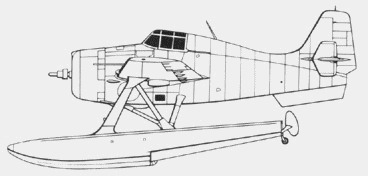
Due to the successful use of fighter seaplanes by Japanese forces in the Pacific, in 1942 Grumman experimented with a new development of its F4F Wildcat. The F4F-3 seaplane conversion was undertaken by the Edo Corporation. Within three months from the Navy request, it was completed. The floats themselves were specially designed for the "Wild Catfish", as this prototype became known, and the entire airframe was subjected to stress analysis and some strengthening. To compensate for the decreased stability, resulting from the extra area of the floats forward of the planes center of gravity, additional rudder area was required, and this was provided by fitting small additional surfaces at the tips of the tail. The F4F-3 floatplane, sometimes referred to as the F4F-3S, first flew on February 28, 1943 and under its Navy contract. Edo provided 100 sets of float conversion kits in great speed, but the changing nature of the war in the Pacific made it unnecessary to proceed with further floatplane conversions, and the project was canceled.
	Type:           		Fighter
	Crew:           		1, Pilot
	Armament:       		six .50 cal machine guns

	Specifications
        		Length:              	N/A
        		Height:               	N/A
        		Wingspan:         	38' (11.58 m)
        		Wing area:         	259.97 sq. ft (24.15 sq. m)
        		Empty Weight:   	N/A
        		Max Weight:      	N/A

	Propulsion
        		No. of Engines:  	1
        		Powerplant:        	Pratt & Whitney R-1830-36 Twin Wasp
        		Horsepower:      	1200 hp

	Performance
        		Range:               	N/A
        		Cruise Speed:    	N/A
        		Max Speed:       	N/A
        		Ceiling:              	N/A
Grumman F5F Skyrocket
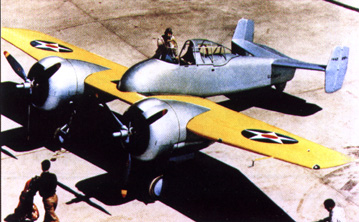
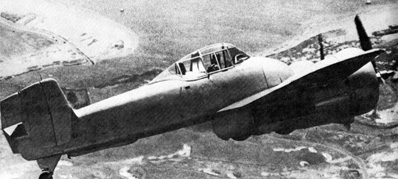
In 1938, Grumman presented a proposal to the Navy for a twin engine carrier based fighter. Named the G-34, the design was unlike any aircraft that had ever been considered before by the U.S. Navy. Grumman's concept called for a light weight (under 10,000 lbs max takeoff weight) aircraft powered by two 1,200 hp Wright R-1820 engines. Being a low wing monoplane, the fuselage began behind of the wings leading edge. At the rear of the short fuselage, the tail assembly was slightly different from a B-25 Mitchell. The propellers were geared to rotate in opposite directions to cancel the effects of engine torque, and the tail wheel was fully retractable. The proposed armament was two 23mm Madsen cannons. The Navy placed an order for one prototype, designated the XF5F-1, on June 30, 1938. The prototype took off for the first time on April 1, 1940. The XF5F-1 demonstrated good flight performance, attaining a maximum speed of 383 mph at 20,000 feet. Its rate of climb was better than the F4F Wildcat, but despite modifications, Grumman failed to gain any production orders from the Navy. A different version with a longer nose and tricycle landing gear was built for the Army Air Corps under the designation XP-50, though only one prototype was built. However, the investment of time and money devoted to the XF5F-1 and the XP-50 was not wasted. These aircraft provided a base of data which was applied to Grumman's new G-51 proposal, which was to eventually became the F7F Tigercat. Meanwhile, the XF5F-1 continued in R&D service until the end of 1944.
	Type:			Fighter
	Crew:			1, Pilot
	Armament: 		two 23mm Madsen cannons (proposed)

	Specifications:
		Length:        	28' 8.5" (8.7 m)
		Height:        	11' 4" (3.45 m)
		Wingspan:      	42' 0" (12.8 m)
		Wing area:	303.5 sq. ft (28.19 sq. m)
		Empty Weight:  	8,107 lb (3677 kg)
		Maximum Weight:     10,138 lb (4598 kg)

	Propulsion:
		No. of Engines:	2
		Powerplant:    	Wright XR-1820-40/42 Cyclone radials
		Horsepower:	1200 hp each

	Performance:
		Range:	                 1,200 miles (1931 km)
		Cruise Speed:            210 mph (337 km/h)
		Max Speed:               383 mph (616 km/h)
		Ceiling:                      33,000 ft (10058 m)
Grumman F6F Hellcat
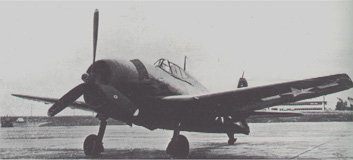
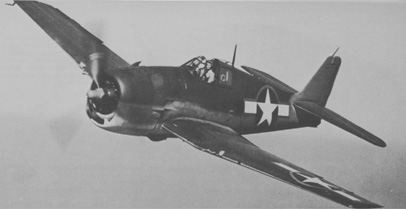
The Grumman F6F Hellcat was another carrier based fighter plane built to replace its predecessor the F4F Wildcat in the U.S. Navy. The Hellcat was a rivals with the Vought F4U Corsair, to be used as a carrier based fighter. However, the Corsair's significant carrier landing issues allowed the Hellcat to become the Navy's dominant fighter in the second part of World War II, a position the Hellcat did not relinquish. The Corsair instead was primarily deployed to great effect in land-based use by the U.S. Marine Corps. Although the F6F resembled the Wildcat in some ways, it was a completely new design, powered by a 2,000 hp Pratt and Whitney R-2800, the same powerplant used for both the Corsair and the U.S. Air Force's Republic P-47 Thunderbolt fighter planes. Some military observers tagged the Hellcat as the "Wildcat's big brother". The F6F was best known for its role as a rugged, well-designed carrier fighter which was able, after its combat debut in early 1943, to counter the Mitsubishi A6M Zero, and help secure air superiority over the Pacific Campaign. The quality of the basic, simple, straightforward design, allowed the Hellcat to be the least modified fighter of the war, with a total of 12,200 being built in just over two years. Hellcats were credited with destroying 5,223 aircraft while in service with the U.S. Navy, U.S. Marine Corps and the Royal Navy's Air Corps.This was more than any other Allied naval aircraft. Postwar, the Hellcat was phased out of frontline service, but remained in service as late as 1954 as a night fighter.
	Type:           		Fighter
	Crew:           		1, Pilot
	Armament:   		six .50 cal machine guns

	Specifications
        		Length:              	33' 7" (10.24 m)
        		Height:                	13' 1" (3.99 m)
        		Wingspan:           	42' 10" (13.5 m)
        		Wing area:          	3344 sq. ft (313 sq. m)
        		Empty Weight:    	9238 lbs (4189 kg)
        		Max Weight:        	15413 lbs (6990 kg)

	Propulsion
       		 No. of Engines:   	1
       		 Powerplant:         	Pratt & Whitney R-2800-10W
      		 Horsepower:       	2000 hp

	Performance
        		Range:                 	945 miles (1521 km)
        		Cruise Speed:      	168 mph (270 km/hr)
        		Max Speed:          	380 mph (611 km/hr)
        		Ceiling:                 	37300 ft (11368 m)
Grumman F7F Tigercat
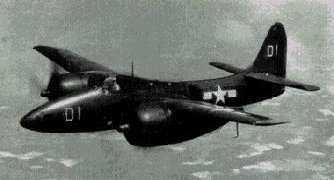
In 1938 the U.S. Navy contracted for the development of a prototype twin-engined carrier-based fighter, designated the X5F-1. While the prototype did not enter production, its evolution and testing gave Grumman valuable experience in this type. In early 1941 Grumman began work on a new twin-engined Navy fighter, designed to have high performance and unprecedented firepower. A contract was set in place in June 1941, with the first flight taking place in December of 1943. The new aircraft, known as the F7F Tigercat, featured foldable wings and tricycle landing gear, with four 20mm cannons and four .50 cal machine guns providing an impressive offensive. In addition, it could carry either a pair of 1000 pound bombs or a single torpedo. Grumman received a contract for 500 Tigercats, which were to be supplied to the U.S. Marines to provide close-air support for their operations. Unfortunately the production Tigercats materialized too late to see operational service with the USMC before the end of the war. 288 F7Fs (including 64 night fighter versions) were built before the cancellation of remaining orders. Some Marine squadrons continued to use the Tigercat in the postwar years, but they were eventually replaced by their jet-powered successors.
	Type:           		Fighter
	Crew:           		1, Pilot
	Armament:   		four 20mm cannon, four .50 cal machine guns, optional torpedo, 1000 lbs. bombs

	Specifications
        		Length:      	45' 4" (13.82 m)
        		Height:            	16' 7" (5.5 m)
        		Wingspan:       	51' 6" (1.68 m)
        		Wing area:       	455 sq. ft (42.27 sq. m)
        		Empty Weight:   	16270 lbs (7378 kg)
        		Max Weight:   	25720 lbs (11670 kg)

	Propulsion
        		No. of Engines: 	2
        		Powerplant:     	Pratt & Whitney R-2800-34W
        		Horsepower:     	2100 hp each

		Performance
        		Range:          	1200 miles (1932 km)
        		Cruise Speed:   	222 mph (357 km/hr)
        		Max Speed:      	435 mph (700 km/hr)
        		Ceiling:        	40700 ft (12405 m)
Grumman F8F Bearcat
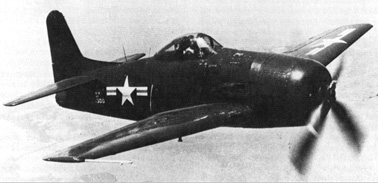
The Grumman F8F Bearcat was an American fighter monoplane for the U.S. Navy of the 1940s. It went on to serve into the mid-20th century in the U.S. Navy, the USMC and the air forces of other nations. It would be Grumman's last piston-engined fighter aircraft to be produced.The Bearcat was designed as an interceptor fighter, with emphasis placed on excellent maneuverability, good low-level performance, and a high rate of climb. It used the same engine as its predecessor the Hellcat, but being smaller and 20% lighter, it had a 30% better climb rate than the Hellcat. Its first flight was in August 1944, and while the first squadron of Bearcats was heading for the Pacific, the war ended. This excellent fighter would not see operational use in World War II.
	Type:           		Fighter
	Crew:           		1, Pilot
	Armament:       		four 20mm cannon

	Specifications:
        		Length:           	27' 6" (8.38 m)
        		Height:           	13' 8" (4.17 m)
        		Wingspan:       	36' 6" (11.12 m)
        		Wing area:       	244  sq. ft (22.67 sq. m)
        		Empty Weight:   	7070lbs (3206 kg)
        		Max Weight:     	12947lbs (5871 kg)

	Propulsion:
        		No. of Engines: 	1
        		Powerplant:     	Pratt & Whitney R-2800-34W
        		Horsepower:    	2100 hp

	Performance:
        		Range:            	1105 miles (1779 km)
        		Cruise Speed:   	163 mph (262 km/hr)
        		Max Speed:      	434 mph (698 km/hr)
        		Ceiling:          	38900 ft (11856 m)
McDonnell FD/FH Phantom
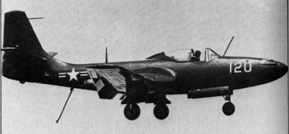
The McDonnell FD Phantom was a twin-engine jet fighter plane designed and first flown during WWII for the U.S. Navy. The Phantom was the first purely jet-powered aircraft to land on an American aircraft carrier and the first jet deployed by the U.S. Marine Corps. Although its frontline service was relatively brief, it helped prove the need and use of carrier based jet planes. Furthermore, it was McDonnell's first successful fighter, leading to the development of its later sibling the F2H Banshee, one of the two most important naval jet fighters of the Korean War. Only 62 FH-1's were built before production switched to the more powerful F2H Banshee. The plane was originally designated the FD Phantom but it was later renamed the FH Phantom when it entered production.
	Type:			Jet Fighter
	Crew:			1, Pilot
	Armament:		four .50 cal machine guns in nose

	Specifications:
		Length:        	38' 9" (11.81 m)
		Height:        	14' 2" (4.32 m)
		Wingspan:      	40' 9" (12.42 m)
		Wing area:	276 sq. ft (25.64 sq. m)
		Empty Weight:  	6683 lb (3031 kg)
		Max Weight: 	12,035 lb (5459 kg)

	Propulsion:
		No. of Engines:	2
		Powerplant:    	Westinghouse J30-WE-20 turbojet
		Horsepower:	1600 lb. thrust each

	Performance:
		Range:		980 miles (1577 km)
		Cruise Speed:   	284 mph ( 399 km/h)
		Max Speed:      	479 mph ( 771 km/h)
		Ceiling:       	41,100 ft (12,525 m)
Ryan FR Fireball
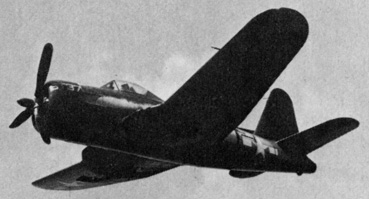
In the end of 1942 the U.S. Navy drew up a specification for a new fighter-bomber with a mixed half jet/half piston engine, which would use one of the new turbojets then being developed, as well as a more conventional radial engine with propeller. The idea was that the piston engine would be used for landing operations, long-range cruising, extra speed to supplement the turbojet, and as an insurance policy against the possible failure of the jet engine. Ryan provided the best proposal, and was awarded the contract, with the first prototype being flown in June 1944. The Fireball was the first U.S. Navy production aircraft to have a flush riveted exterior and metal-covered control surfaces. With contracts calling for 1,300 Fireballs, the FR-1s began to equip the Navy in March 1945; however, VJ-Day cancellations left only 66 planes produced. None of these saw combat duty during the war, but Fireballs were used for carrier trials after the war until being withdrawn in late 1947.
	Type:			Fighter-bomber
	Crew:			1, Pilot
	Armament:		four .50 inch machine guns, up to 1,000 lb. of bombs, or eight 5" rockets

	Specifications:
		Length:        	32' 4" (9.86 m)
		Height:        	13' 7.25" (4.15 m)
		Wingspan:      	40' 0" (12.19 m)
		Wing area:	275 sq. ft (25.55 sq. m)
		Empty Weight:  	7915 lb (3590 kg)
		Max Weight: 	10,595 lb (4806 kg)

	Propulsion:
		No. of Engines:	2
		Powerplant #1: 	Wright R-1820-72W Cyclone radial
		Powerplant #2: 	General Electric J31-GE-3 turbojet
		Horsepower:	1425 hp (piston)+1600 lb thrust (jet)

	Performance:
		Range:		1030 miles (1658 km)
		Cruise Speed:   	153 mph ( 246 km/h)
		Max Speed (both):  	426 mph ( 686 km/h)
		Max Speed (piston):  	295 mph ( 745 km/h)
		Ceiling:       	43,100 ft (13,135 m)
Boeing P-26 Peashooter
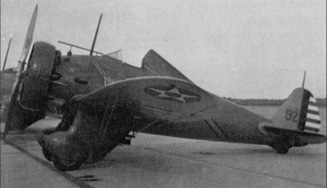
The Boeing P-26 Peashooter was the first American all-metal production fighter plane and the first pursuit monoplane used by the U.S. Army Air Corps. Designed and built by Boeing the prototype first flew in 1932, and the type was still in use with the U.S. Army Air Corps as late as 1941 in the Phillipines. The P-26 design development began in September 1931. Like many other aircraft of the early 30's, the P-26 had an open cockpit, fixed landing gear, and externally braced wings. The Army eventually ordered 174 examples of the small fighter. Although the P-26 had been retired from front-line service by the time the U.S. entered the war, P-26s were stationed at Pearl Harbor, Hawaii and in the Phillipines (with the Phillipine Air Force) when the Japanese attacked in December 1941.
	Type:           		Fighter
	Crew:           		1, Pilot
	Armament:       		two .50 inch machine guns, or one .50 inch and one .30 inch machine gun

	Specifications:
        		Length:         	23' 7.25" (7.19 m)
        		Height:         	10' 0.5" (3.06 m)
        		Wingspan:       	27' 11.5" (8.52 m)
        		Wing area:      	149.5 sq. ft (13.89 sq. m)
        		Empty Weight:   	2197 lb (997 kg)
        		Max Weight:     	2955 lb (1340 kg)

	Propulsion:
        		No. of Engines: 	1
        		Powerplant:     	Pratt & Whitney R-1340-27 radial
        		Horsepower:     	500 hp

	Performance:
        		Range:          	360 miles (579 km)
        		Cruise Speed:   	199 mph ( 320 km/h)
        		Max Speed:      	234 mph ( 377 km/h)
        		Ceiling:        	27,400 ft (8350 m)
Republic (Seversky) P-35A "Guardsman"
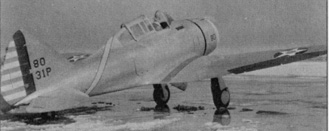
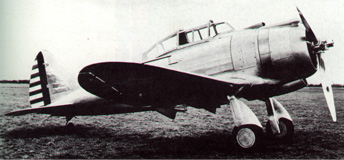
In 1935 the USAAC began a series of design competitions in order to procure an advanced monoplane fighter. An aircraft designed as a private venture by the Seversky Aircraft Corporation was entered into the competition, but after an accident the aircraft was redesigned with retractable landing gear and a more powerful engine. This version impressed the USAAC enough that they ordered 77 examples, and designated them the P-35. P-35s began to enter service in July 1937, with 76 of them being delivered by August 1938. In 1939 Seversky changed its name to Republic Aviation, and began producing an export version of the P-35 that had a more powerful engine and two additional machine guns. All 60 of these aircraft were meant for Sweden, but in October 1940 they were all requisitioned by the U.S. government and given the designation P-35A. In 1941, 48 of the P-35As were sent to the U.S. bases in the Phillipines, but after the Japanese attacks on December 7, only eight were left flyable.
	Type:           		Fighter
	Crew:           		1, Pilot
	Armament:       		two .30 cal machine guns, two .50 cal machine guns, up to 350 lbs. of bombs

	Specifications:
        		Length:        	26' 10" (8.18 m)
        		Height:         	9' 9" (2.97 m)
        		Wingspan:       	36' 0" (10.97 m)
        		Wing area:      	220 sq. ft (20.44 sq. m)
        		Empty Weight:   	4575 lb (2075 kg)
        		Max Weight:     	6723 lb (3050 kg)

	Propulsion:
        		No. of Engines: 	1
        		Powerplant:     	Pratt & Whitney R-1830-45 Twin Wasp radial
        		Horsepower:     	1050 hp

	Performance:
        		Range:          	950 miles (1529 km)
        		Cruise Speed:   	260 mph ( 418 km/h)
        		Max Speed:      	310 mph ( 499 km/h)
        		Ceiling:        	31,400 ft (9570 m)
Curtiss P-36 Hawk
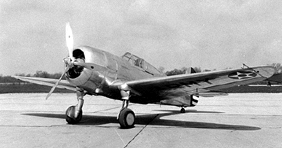
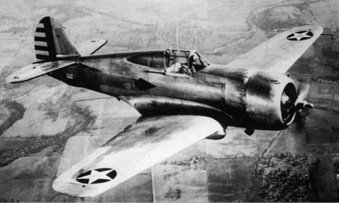
The Curtiss P-36 Hawk, also known as the Curtiss Hawk Model 75, was an American-designed and built fighter aircraft of the 1930s and 40s. A contemporary of both Hawker Hurricane and Bf-109, it was one of the first of a new generation of combat aircraft - a sleek monoplane design making extensive use of metal in its construction and powered by a powerful radial engine. The Hawk was the predecessor to the Curtis P-40 Warhawk. By the beginning of WWII the P-36 was already considered obsolete the P-36 saw little combat with the United States during World War 2. It was nevertheless the fighter used most extensively and successfully by the French, during the Battle of France. The P-36 was also ordered by the governments of the Netherlands and Norway, but did not arrive in time to see action over either country. Circumstances compelled limited use of P-36s in the opening stages of hostilities with Japan, but they were very soon relegated for use as a second-line aircraft in the training role.
	Type:           		Fighter
	Crew:           		1, Pilot
	Armament:       		two .30 cal machine guns

	Specifications:
        		Length:         	28' 6" (8.69 m)
        		Height:         	8' 5" (2.57 m)
        		Wingspan:       	37' 4" (11.38 m)
Empty Weight: 4567 lb (2017 kg)
		Max Weight:	6010 lb (2732 kg)

 	Propulsion
        		No. of Engines: 	1
       		Powerplant:     	Pratt & Whitney R-1830
        		Horsepower:     	1050 hp

 	Performance:
        		Range:          	830 miles (1336.00 km)
        		Cruise Speed:   	250.00 mph (402.00 km/h)
        		Max Speed:      	313.00 mph (504.00 km/h)
        		Ceiling:        	37200.0 ft (11338 m)
Lockheed P-38 Lightning
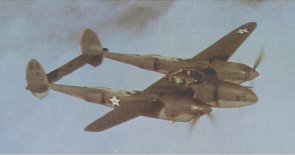
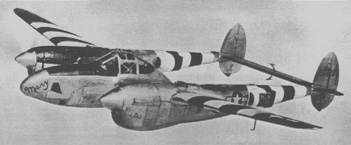
The Lockheed P-38 Lightning was a World War 2 American Fighter plane built by Lockheed. Developed to a United States Army Air Corps requirement, the P-38 had a distinctive twin boom tail and a single, central body containing the cockpit and armament. Named "fork-tailed devil" by the Luftwaffe and "two planes, one pilot" by the Japanese, the P-38 was used in a number of roles, including ground attack, night fighting, dive bombing, level bombing, photoreconnaissance, and extensively as a long range escort. It served in all theaters of war, and was the main aircraft of many of America's top aces in the Pacific theater. Including Major Richard Bong who scored 40 kills flying P-38s in the Pacific. P-38s were also used in the famous mission that intercepted and shot down Japanese admiral Isoroku Yamamoto over Bougainville. The P-38's high speed and large nose section (which was a good location for recon cameras) made the plane a natural for photographic reconnaissance missions. P-38s that were used in this role were re-designated as F-4s and F-5s.
	Type:           		Fighter
	Crew:           		1, Pilot
	Armament:       		one 20mm cannon, four .50 cal machine guns

	Specifications:
        		Length:         	37' 10" (11.53 m)
        		Height:         	12' 10" (3.91 m)
        		Wingspan:       	52' 0" (15.85 m)
        		Wing area:      	328 sq. ft (30.47 sq. m)
        		Empty Weight:   	11780 lbs (5342 kg)
        		Max Weight:     	15500 lbs (7029 kg)

	Propulsion:
        		No. of Engines: 	2
        		Powerplant:     	Allison V-1710-27/29
        		Horsepower      	1150 hp each

	Performance:
        		Range:          	500 miles (805 km)
        		Cruise Speed:   	300 mph (483 km/hr)
        		Max Speed:      	390 mph (628 km/hr)
        		Ceiling:        	39000 ft (11887 m)
Bell P-39 Airacobra
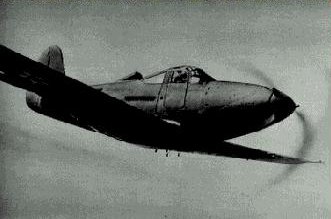
The P-39 Airacobra was the first US Army fighter with tricycle landing gear, and was also unique for having its engine placed behind the pilot in the middle of the aircraft. Other interesting features included a 37mm cannon firing through the propeller hub, and access to the cockpit with a door in the fuselage (as opposed to a moveable canopy). While not noteable as an air-to-air fighter (in American hands), the P-39 performed well as a ground attack aircraft. However, the Russians received nearly 5000 P-39s through the lend-lease program, and they used them successfully as air defense fighters on the Eastern Front. About 200 P-39s originally designated for export to the British were repossessed by the USAAF, and were known as P-400s; these were used in the early Southwest Pacific campaigns such as at Guadalcanal.
	Type:           		Fighter
	Crew:           		1, Pilot
	Armament:       		one 37mm T9 cannon, two .50 cal machine guns, four .30 cal machine guns

	Specifications:
        		Length:         	30' 2" (9.19 m)
        		Height:         	11' 10" (3.61 m)
        		Wingspan:       	34' 0" (10.36 m)
        		Wing area:      	213  sq. ft (19.79 sq. m)
        		Empty Weight:   	6300 lbs (2857 kg)
        		Gross Weight:   	7650 lbs (3469 kg)
        		Max Weight:     	8850 lbs (4013 kg)

	Propulsion:
        		No. of Engines: 	1
        		Powerplant:     	Allison V-1710-35
       		Horsepower:     	1150 hp

	Performance:
        		Range:          	350 miles (563 km)
       		Max Speed:      	360 mph (579 km/hr)
        		Ceiling:        	31900 ft (9722.6 m)
Curtiss P-40
Tomahawk, Kittyhawk, Warhawk
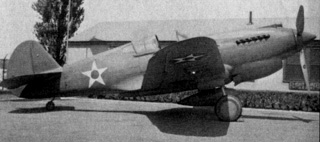
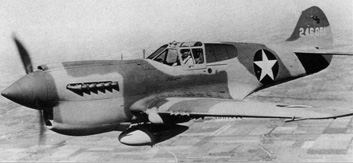
The P-40 is best known as the aircraft used by Claire Chennault's American Volunteer Group ("The Flying Tigers"). While not an outstanding fighter, it was well used during the first half of the war (especially in the Pacific theater), until it was replaced by more capable types. Not counting the P-47 or the P-51, it was the most extensively built US fighter, with almost 14,000 units being delivered before production ended in 1944.
	Type:           		Fighter
	Crew:           		1, Pilot
	Armament:       		six .50 cal machine guns

	Specifications:
       		 Length:         	31' 9" (9.68 m)
        		Height:         	12' 4" (3.76 m)
        		Wingspan:       	37' 4" (11.38 m)
        		Max Weight:   	8810 lbs (4000 kg)

	Propulsion:
        		No. of Engines: 	1
        		Powerplant:     	Allison V-1710
        		Horsepower:     	1150 hp

	Performance:
        		Range:          	850 miles (1368 km)
        		Cruise Speed:   	235 mph (378 km/h)
        		Max Speed:      	362 mph (582 km/h)
       		Ceiling:        	30000 ft (9143.6 m)
Republic P-43 Lancer
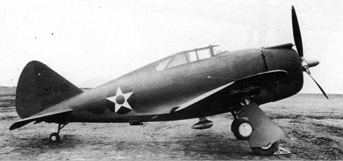
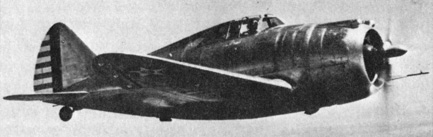
After Republic had finished the production run of the P-35a, it set about to develop a more advanced version of that aircraft. Two different projects resulted from this, the XP-41, and the P-43. Both had more powerful engines than the P-35A, and a redesigned airframe that was far more aerodynamic than its predecessor. Testing of these prototypes resulted in a USAAC contract for 13 P-43s in March 1939. While all P-43s were in service by April 1941, it had become obvious that the latest improvements were still not up to par with the new aircraft developed in Europe. Although Republic had already developed a more advanced version known as the P-44, all types that had been ordered were cancelled in September 1940 in favor of a more advanced design which was to become the Republic P-47 Thunderbolt. While the P-47 was being developed, the USAAC ordered 54 P-43s and 80 P-44s, and 107 more examples were delivered to China. The P-43s and P-44s in USAAC service were considered unsuitable for combat operations, and all were converted for use as photo-reconnaissance aircraft.
	Type:           		Fighter
	Crew:           		1, Pilot
	Armament:       		four .50 cal machine guns, six 20 lb. bombs

	Specifications:
       		Length:         	28' 6" (8.69 m)
        		Height:         	14' 0" (4.27 m)
        		Wingspan:       	36' 0" (10.97 m)
        		Wing area:      	223 sq. ft (20.72 sq. m)
        		Empty Weight:   	5996 lb (2720 kg)
        		Max Weight:     	8480 lb (3846 kg)

	Propulsion:
       		No. of Engines: 	1
        		Powerplant:     	Pratt & Whitney R-1830-57 Twin Wasp radial
       		Horsepower:     	1200 hp

	Performance:
        		Range:          	650 miles (1046 km)
        		Cruise Speed:   	280 mph ( 451 km/h)
        		Max Speed:      	356 mph ( 573 km/h)
        		Ceiling:        	36,000 ft (10,975 m)
Republic P-47 Thunderbolt
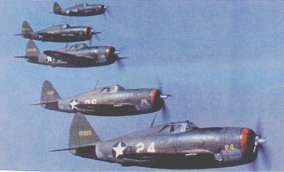
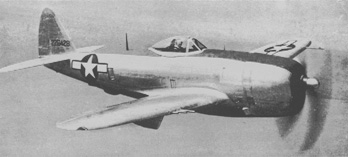
Affectionately know as "the Jug", the P-47 was a heavy (7-ton) fighter for its time. Designed as an interceptor, it found its true role as a hard-hitting ground-attack aircraft. Its great structural strength and massive radial engine that could withstand damage better than that of in-line engined fighters like the P-51 and P-38 helped it survive the punishment typically incurred on low-flying aircraft. With drop tanks the P-47 could escort bombers as far as Berlin, and while it served admirably in this role, most USAAF groups had switched to the Mustang by the end of the war.
	Type:           		Fighter
	Crew:           		1, Pilot
	Armament:       		six or eight .50 cal machine guns

	Specifications (P-47N):
        		Length:            	36' 1" (11.0 m)
        		Height:            	14' 7" (4.44 m)
        		Wingspan:       	42' 7" (12.98 m)
        		Wing Area:        	322 sq. ft. (29.91 sq. m)
        		Empty Weight:   	11,000 lbs (4990 kg)
        		Max Weight:     	20,700 lbs (9389 kg)

	Propulsion:
        		No. of Engines: 	1
        		Powerplant:     	Pratt & Whitney R-2800-77
        		Horsepower:     	2800 hp

	Performance:
        		Range:            	800 miles (1297 km)
       		Cruise Speed:   	300 mph (483 km/hr)
       		Max Speed:     	467 mph (762 km/hr)
        		Ceiling:           	43,000 ft (13,105 m)
North American P-51 Mustang
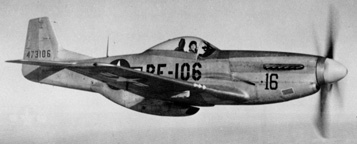
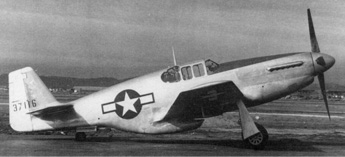
Type: Fighter
Crew: 1, Pilot
Armament: six. 50 cal machine guns
Specifications:
Length: 32' 3" (9.80 m)
Height: 13' 8" (4.17 m)
Wing span: 37' (11.30 m)
Wing area: 235 sq. ft (21.80 sq. m)
Empty Weight: 7000 lbs (3175 kg)
Gross Weight: 9200 lbs (4173 kg)
Max Weight: 12100 lbs (5487 kg)
Propulsion:
No. of Engines: 1
Powerplant: Rolls Royce (Packard) Merlin V-1650
Horsepower: 1650 hp
Performance:
Range: 1000 miles (1610 km)
Cruise Speed: 275 mph (442 km/hr)
Max Speed: 437 mph (703 km/hr)
Ceiling: 41900 ft (12770 m)
Bell P-59 Airacomet
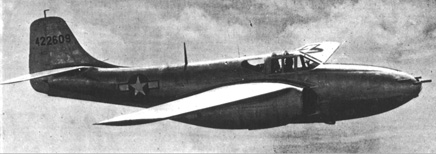
In 1941 Bell Aircraft Corporation began designing what would become the United State's first jet fighter. General Electric provided the jet engines, based on a British design. Indeed, it was the proximity to the G.E. plant that led to Bell receiving the contract. Only about 66 examples were built up through 1944. Flown for test and evaluation for the USAAF, the P-59 was found to have inadequate performance and proved to be an indifferent gun platform. As a result no further examples were built. Some of the lessons learned with the P-59 came in handy with the Lockheed P-80 Shooting Star, which was more successful as an early jet fighter.
	Type:           		Jet Fighter
	Crew:           		1, Pilot
	Armament:       		one 37mm M4 cannon in nose, three .50 cal machine guns in nose

	Specifications:
        		Length:         	38' 1.5" (11.62 m)
        		Height:         	12' 0" (3.66 m)
        		Wingspan:       	45' 6" (13.87 m)
        		Wing area:      	385.8 sq. ft (35.84 sq. m)
        		Empty Weight:   	8165 lb (3704 kg)
        		Max Weight:     	13,700 lb (6214 kg) max at takeoff

	Propulsion:
        		No. of Engines: 	2
        		Powerplant:     	General Electric J31-GE-5 turbojet
        		Horsepower:     	2000 lb (907kg) thrust each

	Performance:
        		Range:          	400 miles (644 km)
        		Cruise Speed:   	375 mph ( 604 km/h)
        		Max Speed:     	409 mph ( 658 km/h) at 35,000 ft
        		Ceiling:        	46,200 ft (14,080 m)
Curtis-Wright P-60
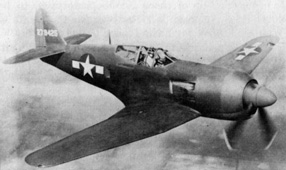
The P-60 began in 1940 as a design meant to be an improved version of the Curtiss P-40. Given the designation XP-53, the type was changed to XP-60 when the powerplant was replaced with the Rolls Royce Merlin engine. Due to the short supply of Packard-built Merlins, the aircraft was developed with five other engines, each in its own prototype. Testing of certain XP-60s continued into 1944, but the results were disappointing, and the US Army abandoned all interest.
	Type:           		single seat interceptor fighter
	Crew:           		1, Pilot
	Armament:       		four .50 cal machine guns in wings

	Specifications:
        		Length:         	33' 11" (10.34 m)
       		Height:         	12' 4.25" (3.77 m)
        		Wingspan:       	41' 3.75" (12.59 m)
        		Wing area:      	275.15 sq. ft (25.56 sq. m)
        		Empty Weight:   	8698 lb (3945 kg)
        		Max Weight:     	10,785 lb (4892 kg) max at takeoff

	Propulsion:
        		No. of Engines: 	1
        		Powerplant:     	Pratt & Whitney R-2800-53 Double Wasp radial
        		Horsepower:     	2000 hp

	Performance:
        		Range:          	315 miles (507 km)
        		Cruise Speed:   	N/A
        		Max Speed:      	414 mph ( 666 km/h) at 20,350 ft
        		Ceiling:        	37,900 ft (11,550 m)
Northrop P-61 Black Widow
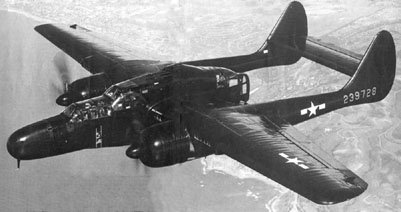
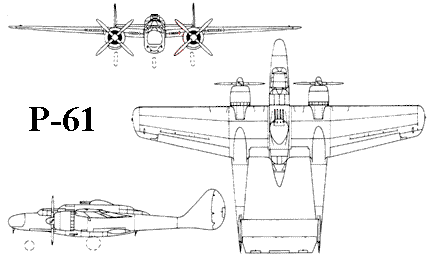
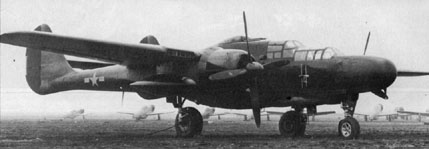
The P-61 has the distinction of being the first US aircraft to be designed as a night fighter. Sporting two engines and twin booms like the P-38 Lightning, the Black Widow was massive for a fighter. Despite teething problems with its radar, the P-61 proved to be a very versatile and effective weapon. A photographic reconnaissance version was also created, and was known as the F-15 Reporter.
	Type:           		Night Fighter
	Crew:           		3
	Armament:       		four 20mm cannon, four .50 cal machine guns in optional dorsal turret

	Specifications:
        		Length:         	49' 7" (15.11 m)
        		Height:         	14' 8" (4.47 m)
        		Wingspan:       	66' (20.12 m)
        		Gross Weight:   	35853 lbs (16260 kg)
        		Max Weight:     	35855 lbs (16260 kg)

	Propulsion:
        		No. of Engines: 	2
        		Powerplant:     	Pratt & Whitney R-2800
        		Horsepower:     	2100 hp each

	Performance:
        		Range:          	1200 miles (1932 km)
        		Cruise Speed:   	275 mph (442 km/hr)
        		Max Speed:      	425 mph (684 km/hr)
        		Ceiling:        	46200 ft (14081 m)
Bell P-63 Kingcobra
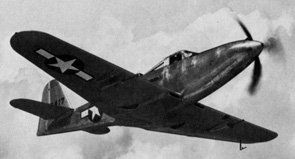
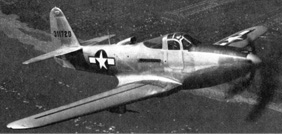
During the development of the Bell P-39 Airacobra it was decided to build a larger and more powerful version for use in a close-support fighter-bomber role. The result was the P-63 Kingcobra, which was similar in layout to the P-39, but it was larger, had a more powerful engine, and had a different tail design. Initial deliveries began in October 1943, and by the time production ended in 1945 more than 3,300 Kingcobras had been built in several versions. The great majority (more than 2,400) were supplied to the USSR under the Lend-Lease program, and about 300 went to the Free French. Very few of the P-63s were delivered to the USAAF, and it is believed that none were used operationally by that service.
	Type:           		close-support fighter/fighter-bomber
	Crew:           		1, Pilot
	Armament:      		one 37mm M4 cannons, four .50 cal machine guns, up to three 522 lb. bombs

	Specifications:
        		Length:         	32' 8" (9.96 m)
        		Height:         	12' 7" (3.84 m)
        		Wingspan:       	38' 4" (11.68 m)
        		Wing area:      	248  sq. ft (23.04 sq. m)
        		Empty Weight:  	 6375 lbs (2892 kg)
        		Takeoff Weight: 	10,500 lbs (4763 kg) maximum

	Propulsion:
        		No. of Engines: 	1
        		Powerplant:     	Allison V-1710-93 inline
        		Horsepower:     	1325 hp

	Performance:
        		Range:          	450 miles (724 km) w/ weapons
        		Max Speed:      	410 mph (660 km/hr)
        		Ceiling:        	43,000 ft (13,110 m)
North American P-64 / NA-50A / NA-68
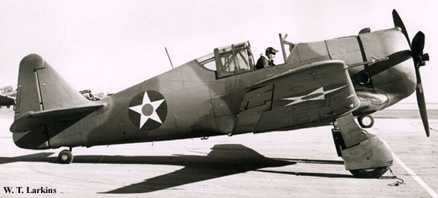
The P-64 was the last version of a line of aircraft that included the BT-9/-14 trainer and the AT-6/SNJ Texan two-seat trainers. The single-seat members of this family were developed as lightweight fighters intended for export. The first in this series was the NA-50A, of which seven were delivered to the Peruvian Air Force in 1939. This was followed by an order for six generally similar aircraft for the Royal Thai Air Force. These were designated NA-68, and were completed and in route to Thailand when Pearl Harbor was attacked. The six NA-68s were seized in Hawaii by the US authorities (Thailand was by now occupied by the Japan), and returned to the United States. Re-designated the P-64, their 20-mm cannon were removed, and they entered service in the USAAC in the advanced trainer role.
	Type:           		Fighter-bomber
	Crew:           		1, Pilot
	Armament:       		two .30 cal machine guns, two 20mm cannon, optionally up to 400 lbs. of bombs externally

	Specifications:
        		Length:         	27' 0" (8.23 m)
        		Height:         	9' 4" (2.84 m)
        		Wing span:      	37' 3" (11.35 m)
        		Wing area:      	227.5  sq. ft (21.13 sq. m)
        		Empty Weight:   	4660 lbs (2114 kg)
        		Max Weight:    	6800 lbs (3084 kg) maximum at takeoff

	Propulsion:
        		No. of Engines: 	1
        		Powerplant:     	Wright R-1820-77 Cyclone 9 radial
        		Horsepower:     	870 hp

	Performance:
        		Range:          	635 miles (1022 km)
        		Max Speed:      	270 mph (435 km/hr)
        		Ceiling:        	27500 ft (8380 m)
Vultee P-66 Vanguard
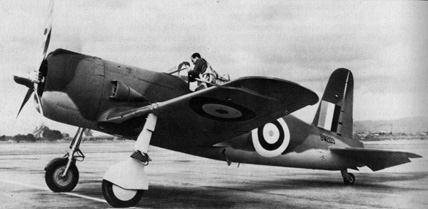
The Vanguard was designed to use common tooling and assemblies from other Vultee products then on the drawing board. The version that evolved into a fighter design was called the Model 48. It was flown in September 1939, but proved to require a redesign of the cowling, and the new version (known as the Model 48X) was first flown in February 1940. This version also incorporated a number of other enhancements, resulting in an order for 166 by Sweden in 1940. No examples were released to Sweden due to U.S. goverment restrictions, but eventually 129 of the Vanguards went to China under the Lend-Lease. The remainder were acquired by the USAAF under the designation P-66, the last being delivered in April 1942. The P-66 in USAAF hands were used in a training role only.
	Type:           		single-seat fighter
	Crew:           		1, Pilot
	Armament:       		four .30 cal machine guns, two .50 cal machine guns

	Specifications:
        		Length:         	28' 5" (8.66 m)
        		Height:         	9' 5" (2.87 m)
        		Wingspan:       	36' 0" (10.97 m)
        		Wing area:      	197 sq. ft (18.30 sq. m)
        		Empty Weight:   	5235 lb (2375 kg)
        		Max Weight:     	7384 lb (3349 kg) max at takeoff

	Propulsion:
        		No. of Engines: 	1
        		Powerplant:    	Pratt & Whitney R-1830-33 Twin Wasp radial
        		Horsepower:     	1200 hp

	Performance:
        		Range:          	950 miles (1529 km)
        		Cruise Speed:   	290 mph ( 467 km/h) at 17,000 ft
        		Max Speed:      	340 mph ( 547 km/h) at 15,100 ft
        		Ceiling:        	28,200 ft (8595 m)
General Motors P-75 Eagle
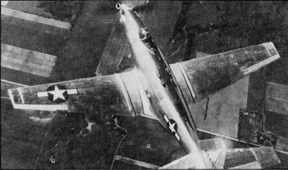
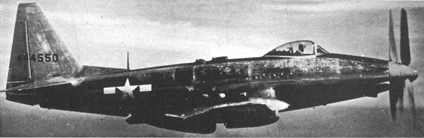
In 1942 the USAAF asked for designs for a high performance fighter with an unprecedented rate of climb, to intercept Japanese bombers in the Pacific theater. The Fisher Body Division of General Motors submitted a design for an aircraft that would use the most powerful inline engine then available, as well as "off-the-shelf" major assemblies (which would shorten development times). The P-75 airframe used the outer wing panels of the Curtis P-40 the tail unit of the Douglass A-24/Dauntless and landing gear of the Vought F4U Corsair. The engine was located in the fuselage behind the pilot, similar to the layout of the Bell P-39. Eight prototypes were ordered by the USAAF, but problems were found during testing. By the time the problems were fixed, other capable fighters (like the P-51 Mustang) were available, and the production contract was cancelled.
	Type:           		single-seat fighter
	Crew:           		1, Pilot
	Armament:       		six .50 inch machine guns in the wings, four .50 inch machine guns in the fuselage, optional 2 600 lb. bombs

	Specifications:
        		Length:         	40' 5" (12.32 m)
        		Height:         	15' 6" (4.72 m)
        		Wingspan:       	49' 4" (15.04 m)
        		Wing area:      	347 sq. ft (32.24 sq. m)
        		Empty Weight:   	11,495 lb (5214 kg)
        		Max Weight:     	18,210 lb (8260 kg) max at takeoff

	Propulsion:
        		No. of Engines: 	1
        		Powerplant:     	Allison V-3420-23 inline
        		Horsepower:     	2885 hp

	Performance:
        		Range:          	2000 miles (3219 km)
        		Cruise Speed:   	310 mph ( 499 km/h)
        		Max Speed:      	420 mph ( 676 km/h) at 20,000 ft
        		Ceiling:        	36,000 ft (10,970 m)
Lockheed P-80 Shooting Star
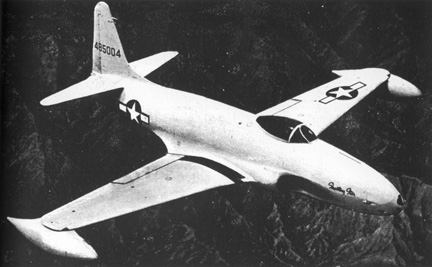
Although the Lockheed P-80 was not the first jet aircraft to enter service with the USAAF (the P-59 Airacobra had that distinction), it was its first operational jet fighter. Design work was begun in 1943 by a team lead by Clarence "Kelly" Johnson (who later went on to design famous aircraft like the SR-71 Blackbird). The first of 13 YP-80s were delivered in October 1944 and shortly before the end of the war in Europe, two of them were assigned in Italy for operational trials. Planned production was for some 5,000 aircraft, but after VJ-Day more than 3,000 were canceled. The remainder went on to help lead the U.S. into the jet age.
	Type:           		fighter, fighter-bomber, reconnaissance a/c
	Crew:           		1, Pilot
	Armament:       		six .50 cal machine guns, optional two 1000 lb. bombs

	Specifications:
        		Length:         	34' 6" (10.52 m)
        		Height:         	11' 4" (3.45 m)
        		Wingspan:       	39' 11" (12.17 m)
        		Wing area:      	238 sq. ft (22.11 sq. m)
        		Empty Weight:   	7920 lb (3592 kg)
        		Max Weight:     	14,500 lb (6577 kg) max at takeoff

	Propulsion:
        		No. of Engines: 	1
        		Powerplant:     	General Electric J33-A-11 turbojet
        		Horsepower:     	4000 lb static thrust

	Performance:
        		Range:          	540 miles (869 km)
        		Cruise Speed:   	410 mph ( 660 km/h)
        		Max Speed:      	558 mph ( 898 km/h)
        		Ceiling:        	45,000 ft (13,715 m)
North American P-82 Twin Mustang
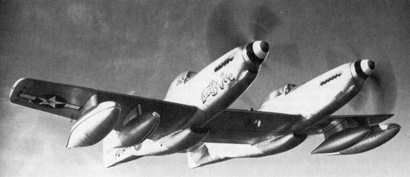
The P-82 came about as a result of a USAAF requirement for a very long range escort fighter for operations in the Pacific, especially to escort the B-29s all the way to Japan and back. The purpose of having two pilots was as a relief against fatigue on the long overwater missions. Only 20 of the 500 ordered had been built before the war's end brought a cancellation to the contracts, but 250 more were built in 1946. Part of this order was for a night fighter version (with a radar operator instead of a second pilot) which was made to replace the Northrop P-61 Black Widow. The P-82 was renamed the F-82 in 1948, and a U.S. F-82 shot down the first enemy aircraft of the Korean War.
	Type:           		Fighter
	Crew:           		2, Pilot, co-pilot/radar operator
	Armament:       		six. 50 cal machine guns

	Specifications:
        		Length:        	42' 5" (12.93 m)
        		Height:         	13' 10" (4.22 m)
        		Wing span:     	51' 3" (15.62 m)
        		Wing area:      	408  sq. ft (37.90 sq. m)
        		Empty Weight:   	15,997 lbs (7256 kg)
        		Takeoff Weight: 	25,591 lbs (11,608 kg) maximum

	Propulsion:
        		No. of Engines: 	2
        		Powerplant:     	Allison V-1710-143/145 inline
        		Horsepower:     	1600 hp each

	Performance:
        		Range:          	2240 miles (3605 km)
        		Cruise Speed:   	286 mph (460 km/hr)
        		Max Speed:      	461 mph (762 km/hr) at 21,000 ft.
        		Ceiling:        	38,900 ft (11,855 m)
Vought V-173 / XF5U-1
"Flying Flapjack" or "Flying Pancake"
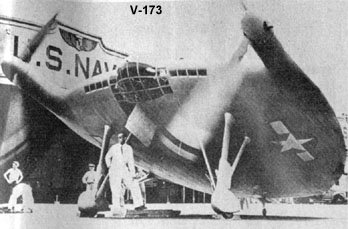
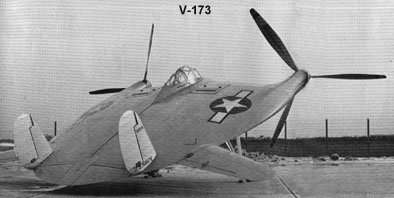
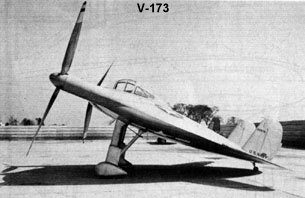
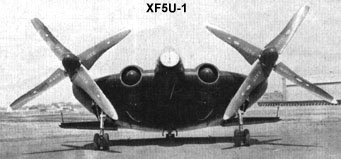
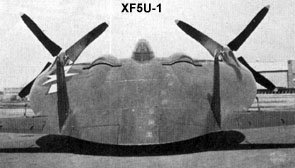
One of the most unusual aircraft ever designed for the U.S. Navy was the Chance Vought V-173, also known as the Zimmerman "Flying Pancake". It was a prototype "proof of concept" aircraft that lacked wings, instead relying on its flat circular body to provide the lifting surface. This multi-million dollar project nearly became the first V/STOL (vertical takeoff and landing) fighter. The V-173 blueprints were shown to the Navy in 1939, with wind tunnel tests on full scale models being done in 1940-41. In January 1942 BuAer requested the proposal for two prototype airplanes of an experimental version of the V-173, known as the VS-135. This version had more powerful engines and was given the military designation XF5U-1. Flight testing of the V-173 went on through 1942 and 1943, resulting in reports of "flying saucers" from surprised Connecticut locals. Mock-ups of the XF5U-1 were done in the summer of 1943, but due to Vought's preoccupation with the Corsair and Kingfisher, the program proceeded slowly during the war. The arrival of the jet age saw the cancellation of the XF5U-1 contract by the Navy in March 1947, despite the fact that the aircraft was due to take its first test flight later that year. The XF5U-1 prototype was scrapped, though the V-173 prototype was saved and was given to the Smithsonian. To this day the V-173 / XF5U-1 project remains one of the more interesting anecdotes in aviation history.
Vought V-173
	Type:           		experimental prototype (Fighter)
	Crew:           		1, Pilot
	Armament:       		none

	Specifications:
        		Length:         	26' 8"
        		Height:         	12' 11"
        		Width:       		23' 4"
        		Gross Weight:  	2,258 lbs

 	Propulsion:
        		No. of Engines: 	2
        		Powerplant:     	Continental A-80
        		Horsepower      	80 hp each
		Prop diameter:	16' 6"

 	Performance:
        		Max Speed:      	138 mph
Vought XF5U-1
	Type:           		Fighter
	Crew:           		1, Pilot
	Armament:       		six .50 cal machine guns, or four 20mm cannon, or two 1000-lb. bombs

	Specifications:
        		Length:         	28' 7.5"
        		Height:         	14' 9"
        		Width:       		32' 6"
        		Empty Weight:   	n/a
        		Gross Weight:   	14550 lbs
       		Max Weight:     	n/a

 	Propulsion:
        		No. of Engines: 	2
        		Powerplant:     	Pratt & Whitney R-2000-7
        		Horsepower      	1600 hp each
		Prop diameter:	16'

 	Performance:
        		Range:          	910 miles
       		Max Speed:      	504 mph at 20,000 ft.
        		Climb:          	3000 ft/min at sea level
        		Ceiling:        	n/a
Curtiss XF14C
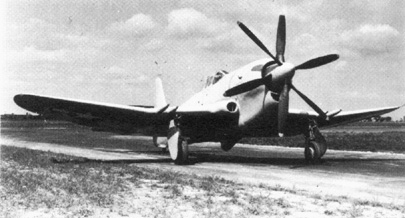
Attempting to regain its position as a supplier of fighter aircraft to the U.S. Navy (a position then dominated by Grumman Aircraft), Curtiss proposed in early 1941 the development of a high-performance, heavily-armed fighter designed around a liquid-cooled engine. At that time the Navy was dedicated to air-cooled engines, but Curtiss' experience with the P-40 gave the company good grounds for its faith in a liquid-cooled unit, and on June 30, 1941 it received a contract for two prototypes, to be designated XF14C-1. The Lycoming XH-2470-4 engine in the first prototype failed to deliver the expected performance during wind tunnel testing, and the Navy eventually concluded that the performance of the XF14C-1 would be inadequate by the time it could be ready to enter service, and the program was cancelled in December 1943. Because the first airframe was virtually complete, the Navy suggested that it be flown with the Wright XR-3350-16 Cyclone engine, driving six-blade contra rotating propellers. In this configuration the aircraft was redesignated XF14C-2, and the first flight was made in July 1944. Performance again fell below expectations, and the R-3350 engine continued to suffer teething problems. The progress of the war in the Pacific made further development of the XF14C-2 unnecessary, and the program was cancelled in the early months of 1945.
	Type:           		single seat interceptor fighter
	Crew:           		1, Pilot
	Armament:       		six .50 cal machine guns or  four 20mm cannons

	Specifications:
        		Length:         	37' 9" (11.51 m)
        		Height:         	12' 4" (3.76 m)
        		Wingspan:       	46' 0" (14.03 m)
        		Wing area:      	375 sq. ft (34.84 sq. m)
        		Empty Weight:   	10,582 lb (4804 kg)
        		Max Weight:     	14,582 lb (6620 kg) max at takeoff

	Propulsion:
        		No. of Engines: 	1
        		Powerplant:     	Wright XR-3350-16 18-cylinder radial
        		Horsepower:     	2300 hp

	Performance:
        		Range:          	1355 miles (2180 km)
        		Cruise Speed:   	296 mph ( 476 km/h)
        		Max Speed:      	424 mph ( 682 km/h) at 32,000 ft
        		Ceiling:        	39,500 ft (12,048 m)
Curtiss XF15C-1
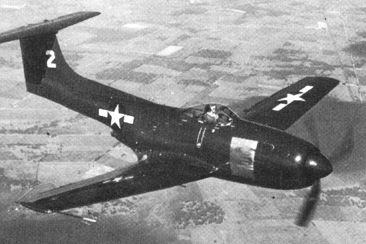
second prototype
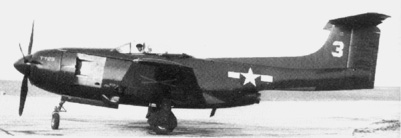
third prototype
The XF15C-1 proved to be the last fighter that Curtiss made for the U.S. Navy. It was developed because of a Navy interest in a composite-engined fighter, taking advantage of the thrust of the then novel jet engine to gain high speed but also using a conventional piston engine to obtain the required range. By the time details of the aircraft had been agreed and a contract for three prototypes had been awarded, on April 7, 1944, Ryan Aircraft was already well advanced with its FR-1 Fireball, of similar concept but lower overall performance. Like the FR-1, the XF15C-1 was intended to cruise on the power of its piston engine, and use the turbojet for takeoff and to boost the speed in combat. The first flight (though without the jet engine) was on February 27, 1945, and a month after the jet engine was installed the first prototype crashed, reportedly due to failure of the piston engine. The second prototype flew on July 9, 1945 and testing continued until the end of 1946. The two surviving aircraft were eventually fitted with T-tails (as in the photos above) to overcome a control problem with the original low-set tailplane. The XF15C-1 was eventually outmoded by the advent of pure jet fighters capable of meeting the Navy's requirements, and the program was canceled.
	Type:           		single seat composite-powered fighter
	Crew:           		1, Pilot
	Armament:       		four 20mm cannons in the wings

	Specifications:
        		Length:        	 44' 0" (13.42 m)
        		Height:         	150' 3" (4.65 m)
        		Wingspan:       	48' 0" (14.64 m)
        		Wing area:      	400 sq. ft (37.16 sq. m)
        		Empty Weight:   	12,648 lb (5742 kg)
       		Max Weight:     	18,698 lb (8490 kg) max at takeoff

	Propulsion:
        		No. of Engines: 2
		Powerplant #1: 	Pratt & Whitney R-2800-34W radial
		Powerplant #2: 	Allis-Chalmers J36 turbojet
		Horsepower:	2100 hp (piston)+2700 lb thrust (jet)

	Performance:
        		Range:          	635 miles (1022 km)
        		Cruise Speed (piston only): 163 mph (262 km/h)
        		Max Speed (both engines): 469 mph (755 km/h) at 25,300 ft
        		Ceiling:        	41,800 ft (12,750 m)
Boeing XF8B-1
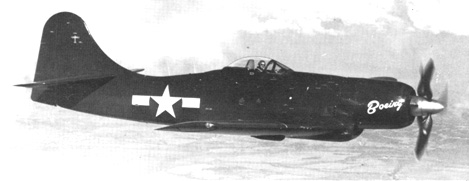
Boeing's Model 400 was designed to U.S. Navy requirements for a long-range carrier-based fighter bomber and a contract for three prototypes was placed with the company on May 4, 1943. The XF8B-1 designation indicated the primary fighting role of the new aircraft, but it was designed from the outset to carry an internal bomb-load of more than 3,000 lb, plus a similar external load, and had production ensued, a change of designation to one in the attack category would probably have been made. The first of the prototypes flew on November 27, 1944, and the Boeing type proved to be the largest and heaviest single-piston-engined fighter developed in the U.S.A. As with other Navy fighters, the wing outer panels folded upwards for carrier storage. The second and third prototypes were completed after the end of the war, by which time the need for the XF8B-1 had disappeared, and further development was soon discontinued.
	Type:           		single seat fighter bomber
	Crew:           		1, Pilot
	Armament:       		six .50 cal machine guns or 20mm cannons, internal storage for four 500 lb bombs or two 1,600 lb bombs,
		       		external racks for two 500 lb, 1000 lb, or 1500 lb bombs.


	Specifications:
        		Length:         	43' 3" (13.18 m)
        		Height:         	16' 3" (4.95 m)
        		Wingspan:       	54' 0" (16.46 m)
        		Wing area:      	489 sq. ft (45.43 sq. m)
        		Empty Weight:   	14,190 lb (6436 kg)
        		Max Weight:     	21,691 lb (9848 kg) max at takeoff

	Propulsion:
        		No. of Engines: 	1
        		Powerplant:     	Pratt & Whitney XR-4360-10 28-cylinder radial
        		Horsepower:     	3000 hp

	Performance:
        		Range:          	1305 miles (2100 km)
        		Climb rate:     	3660 ft/min (18.6 m/sec)
        		Max Speed:      	432 mph ( 695 km/h) at 26,500 ft
        		Ceiling:       	37,500 ft (14438 m)
Bell XFL-1 Airabonita
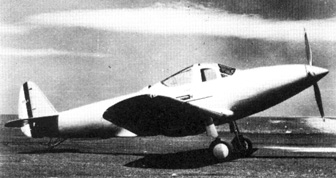
On November 8, 1938 the U.S. Navy placed a contract with the Bell Aircraft Corporation for a single prototype of the company's Model 12 fighter (which was developed for the Army Air Corps as the XP-39). The Navy was not yet ready to consider the use of aircraft with tricycle-landing gear (such as was found on the XP-39) on its aircraft carriers, and the prototype (designated the XFL-1) was therefore to have a tailwheel undercarriage. Other changes included the use of underwing radiators, installation of an arrestor hook, enlarged vertical surfaces and restressing of the airframe for carrier operations. First flight of the XFL-1 took place on May 13, 1940. Problems with the Allison engine delayed delivery of the Airabonita to the U.S. Navy until February 1941, and then undercarriage trouble caused the aircraft to fail its carrier qualification trials. By December 1941, the XFL-1 was back with Bell in New York for modifications, but Navy interest in the type waned quickly after the start of the war and further development of the type was cancelled.
	Type:           		single-seat fighter
	Crew:           		1, Pilot
	Armament:       		one 37mm cannon or one .50 cal machine gun, two .30 cal machine guns

	Specifications:
        		Length:         	29' 9&7/8" (9.09 m)
        		Height:         	12' 9" (3.91 m)
        		Wingspan:       	35' 0" (10.68 m)
        		Wing area:      	232 sq. ft (21.57 sq. m)
        		Weight empty:   	5161 lb (2343 kg)
        		Weight max:     	7212 lb (3274 kg) max at takeoff

	Propulsion:
        		No. of Engines: 	1
        		Powerplant:     	Allison XV-1710-6 12-cylinder Vee liquid-cooled inline
        		Horsepower:     	1,150 hp

	Performance:
        		Cruise Speed:   	296 mph (476 km/h)
        		Max speed:      	336 mph (541 km/h) at 10,000 ft.
        		Ceiling:        	30,900 ft. (9425 m)
        		Range:          	1072 miles (1725 km)
Curtiss XP-46
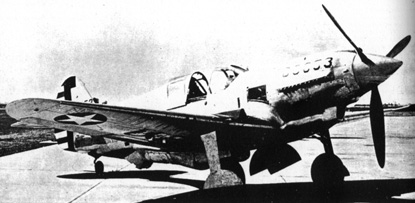
The Curtiss XP-46 was designed as a possible successor to the Curtis P-40, from which it was developed. Among the noticeable ways in which the XP-46 differed from the P-40 was the inwardly-retracting flush landing gear, a lower cockpit canopy, and a ventral ducted radiator located beneath the cockpit. Only two prototypes were built and tests with this design did not justify further development.
	Type:           	single-seat fighter
	Crew:           	1, Pilot
	Armament:      	two .50 cal machine guns in the nose, eight .30 cal machine guns in the wings
Grumman XP-50 Skyrocket
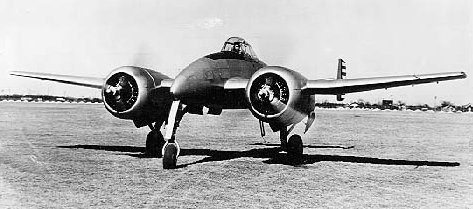
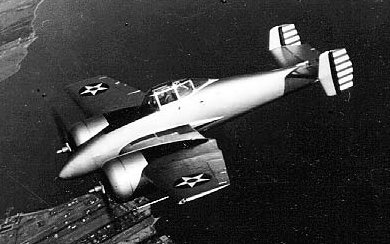
	Type:		Fighter
	Crew:		1, Pilot
	Armament: 	four .50 Fifty caliber machine guns, one 20mm cannon, 165 lbs. bombs

	Specifications:
			Length:        	31' 11"
			Height:        	12'
			Wingspan:      	42'
			Wing area:	unknown
			Empty Weight:  	8,300 lb
			Loaded Weight: 	10,600 lb

	Propulsion:
			No. of Engines:	2
			Powerplant:    	Wright R-1820-67/69 radial
			Horsepower:	1200 hp each

	Performance:
			Range:		1,250 miles
			Cruise Speed:       unknown
			Max Speed:            425 mph
			Ceiling:       	40,000 ft
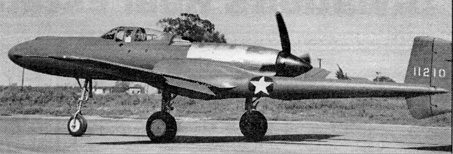
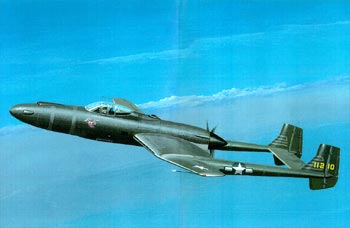
The Vultee XP-54 was designed as a competitor for a 1939 USAAC specification for a single-seat interceptor fighter, competing against the Curtiss-Wright XP-55, and the Northrop XP-56. The engine was initially to have been the Pratt & Whitney X-1800, though this was later changed to the Lycoming XH-2470 24-cylinder engine, making it one of the only U.S. fighters to have been made with a 24 cylinder engine (see also the P-75 Eagle). Other novelties included a pressurized cockpit, and a pilot seat which functioned as an elevator. This seat could be electrically lowered to the ground for cockpit entry, or could be catapulted downward to clear the pilot of the propeller during an emergency. This made the XP-54 the first American fighter to be fitted with an ejector seat. Engine problems and other delays during the testing phase meant that only two XP-54s were made, and the prospect of quantity production was eventually abandoned. The name "Swoose Goose" was more of an unofficial name for this unique aircraft.
	Type:           		single-seat fighter
	Crew:           		1, Pilot
	Armament:       		two .50 cal machine guns in the nose, two 37mm T-12/T-13 cannon in the nose

	Specifications:
        		Length:         	54' 8.75"
        		Height:         	14' 6"
        		Wingspan:      	53' 10"
        		Wing area:      	455.5 sq. ft
       		Empty Weight:   	15,262 lb
        		Max Weight:     	19,337 lb max at takeoff

	Propulsion:
        		No. of Engines: 	1
        		Powerplant:     	Lycoming H-2470 (24 cylinder)
        		Horsepower:     	1850 hp

	Performance:
        		Range:          	N/A
        		Cruise Speed:   	N/A
        		Max Speed:      	381 mph at 28,500 ft
        		Ceiling:        	37,000 ft
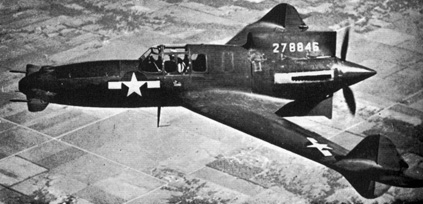
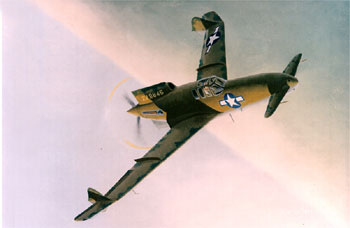
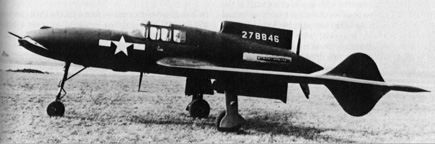
Developed to meet a 1939 USAAC specification for an interceptor fighter, the XP-55 was an unconventional design. It was a swept wing canard pusher aircraft that lacked a tail. Only three prototypes were produced, with the first taking flight in July 1943. Testing continued through 1944, but due to inherent stability problems and poor low-speed handling characteristics the type was abandoned.
	Type:           		single seat interceptor fighter
	Crew:           		1, Pilot
	Armament:       		four .50 cal machine guns in the nose

	Specifications:
        		Length:         	29' 7" (9.02 m)
        		Height:         	10' 0.75" (3.07 m)
        		Wingspan:       	44' 0.5" (13.42 m)
        		Wing area:      	235 sq. ft (21.83 sq. m)
        		Empty Weight:  	6354 lb (2882 kg)
        		Max Weight:     	7929 lb (3597 kg) max at takeoff

	Propulsion:
        		No. of Engines: 	1
        		Powerplant:     	Allison V-1710-95 inline
        		Horsepower:     	1275 hp

	Performance:
        		Range:          	635 miles (1022 km)
        		Cruise Speed:   	296 mph ( 476 km/h)
        		Max Speed:      	390 mph ( 628 km/h) at 19300 ft
        		Ceiling:        	34600 ft (10545 m)
Northrop XP-56 "Black Bullet"
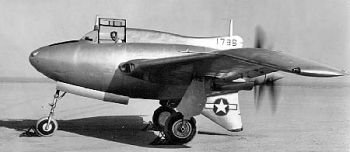
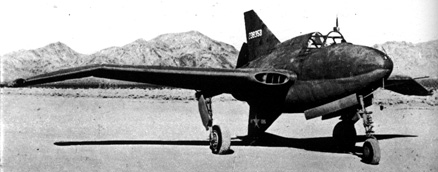
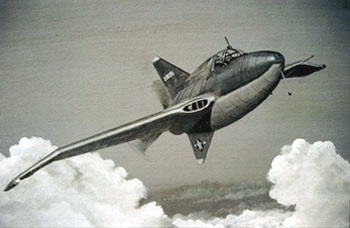
The Northrop XP-56 was designed as a competitor for a 1939 USAAC specification for a single-seat interceptor fighter, competing against the Curtiss-Wright XP-55 , and the Vultee XP-54. Only two prototypes were made, and testing showed it to not only underperform, but be basically un-airworthy. The project was cancelled, but lessons learned from the XP-56 came in handy with later Northrop flying wing designs.
	Type:           		single-seat fighter
	Crew:           		1, Pilot
	Armament:       		four .50 cal machine guns in the nose, two 20mm cannon in the nose

	Specifications:
        		Length:         	27' 6"
        		Height:         	11' 0"
        		Wingspan:       	42' 6"
        		Wing area:      	306 sq. ft
        		Empty Weight:   	8700 lb
        		Max Weight:     	12,145 lb max at takeoff

	Propulsion:
        		No. of Engines: 	1
        		Powerplant:     	Pratt & Whitney R-2800-29 18-cylinder
        		Horsepower:     	2000 hp

	Performance:
        		Range:          	445 miles
        		Cruise Speed:   	N/A
        		Max Speed:      	465 mph at 25,000 ft
        		Ceiling:        	33,000 ft
Lockheed XP-58 Chain Lightning
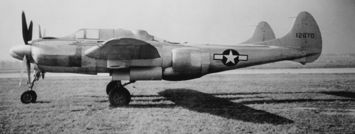
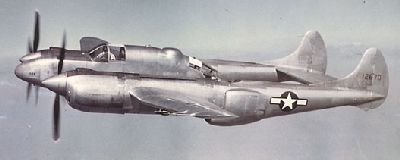
The XP-58 was supposed to be the successor to the Lockheed P-38 Lightning. In April of 1940 an agreement was reached with the USAAC that would enable Lockheed to sell an export version of the Lightning to England and France, provided that Lockheed would design a more advanced version of the P-38 for U.S. needs. The concept aircraft was envisaged as coming in two versions: a single-seat and and a two-seat version (which had rear-firing guns in each of the tail booms). The project soon received a change of direction (one of many to come, and probably the main reason for the overly-long development and ultimate death of the project), in that the single-seat version was dropped, and the rear-facing guns were replaced with a dorsal turret. A number of engine changes later (and with the addition of a ventral turret as well), the XP-58 project was re-designated to be a ground attack aircraft. After several new armament configurations were designed, the purpose of the aircraft changed yet again into that of a "bomber destroyer". Still more changes to the aircraft were mandated, but by the time the single prototype took its maiden flight (after an extended four year development cycle), there was no need for any "bomber destroyers". The project was terminated in 1945, with only a single XP-58 being built.
	Type:           		Fighter/attack aircraft/bomber destroyer
	Crew:          		2, Pilot & Gunner
	Armament:       		four 37mm cannon, four 12.7mm machine gun, up to 4,000 lb bombs

	Specifications:
        		Length:         	49' 5.5" (15.0 m)
        		Height:         	16' 0" (4.8 m)
        		Wingspan:       	70' 0" (21.3 m)
        		Wing area:      	600 sq. ft (55.7 sq. m)
        		Empty Weight:   	31,624 lbs (14,341 kg)
        		Gross Weight:   	39,192 lbs (17,774 kg)
        		Max Weight:     	43,000 lbs (19,501 kg)

	Propulsion:
        		No. of Engines: 	2
        		Powerplant:     	Allison V-3420-11/13
        		Horsepower:      	2600 hp each

	Performance:
        		Range:          	1,250 miles (2,012 km)
        		Cruise Speed:   	283 mph (455 km/hr)
        		Max Speed:      	436 mph (702 km/hr)
        		Climb:          	2,582 ft/min (786 m/min)
        		Ceiling:        	38,200 ft (11,643 m)
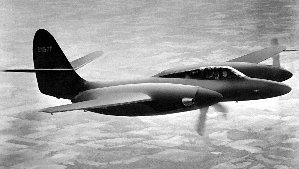
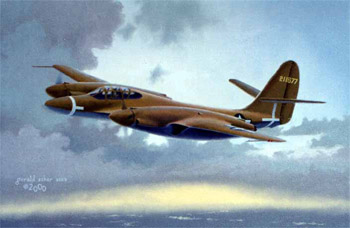
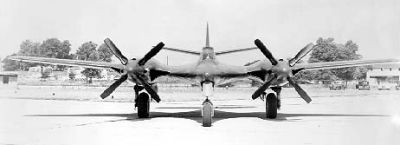
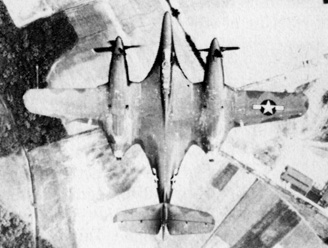
The XP-67 was a somewhat revolutionary design by McDonnell Aircraft. It used two turbo-charged engines whose exhaust was ejected at the rear of the engine nacelle, providing some additional thrust. The pilot was to sit in a pressurized cabin, and the plane's armament was very heavy for a fighter (six 37mm cannon in one prototype, and a 75mm cannon in another prototype). When viewed from above the aircraft had an unusual profile, in that the engine nacelles and fuselage were shaped to provide true aerofoil sections throughout. The first flight was made in January 1944, with testing undertaken later that year. Performance proved to be far from satisfactory, and modifications were made to improve certain stability problems. Before official trials could resume, however, the prototype was extensively damaged by fire and the program was abandoned.
	Type:           		single-seat long-range fighter
	Crew:           		1, Pilot
	Armament:       		six 37mm cannon or one 75mm cannon

	Specifications:
        		Length:         	44' 9.25" (13.65 m)
        		Height:         	15' 9" (4.80 m)
        		Wingspan:       	55' 0" (16.76 m)
        		Wing area:      	414 sq. ft (38.46 sq. m)
        		Empty Weight:   	17,745 lb (8049 kg)
        		Max Weight:     	25,400 lb (11,5321 kg) max at takeoff

	Propulsion:
        		No. of Engines: 	2
        		Powerplant:     	Continental XIV-1430-17/19 contra-rotating inlines
        		Horsepower:     	1350 hp each

	Performance:
        		Range:          	2385 miles (3838 km)
        		Cruise Speed:   	N/A
        		Max Speed:      	405 mph ( 652 km/h) at 25,000 ft
        		Ceiling:        	37,400 ft (11,400 m)
Republic XP-72
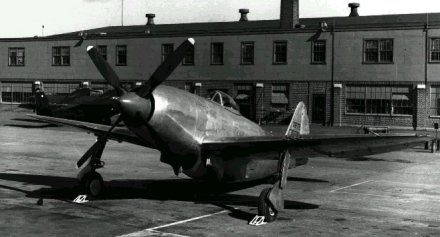
The XP-72 was a more-or-less straightforward progressive development of the P-47 Thunderbolt, designed to be a successor for that very successful aircraft. With a 3450 hp engine, a maximum speed of 500mph was hoped for. After favorable testing of the prototype, the USAAF ordered 100 examples, though the contract was cancelled with the changing course of the war. Only the two prototypes were built, one of which crashed, and the other was eventually scrapped.
	Type:              		Fighter
	Crew:           		1, Pilot
	Armament:       		six .50 cal machine guns or optional four 37-mm cannons, optional two 1000 lb. bombs

	Specifications:
        		Length:         	36' 7"
        		Height:         	16' 0"
        		Wingspan:       	40' 11"
        		Wing Area:      	300 sq. ft.
        		Empty Weight:   	11,476 lbs
        		Max Weight:     	17,490 lbs

	Propulsion:
        		No. of Engines: 	1
        		Powerplant:     	Pratt & Whitney R-4360-13 Wasp Major
        		Horsepower:     	3450 hp

	Performance:
        		Range:         	2520 miles
        		Max Speed:      	490 mph
        		Ceiling:        	42,000 ft
Bell XP-77
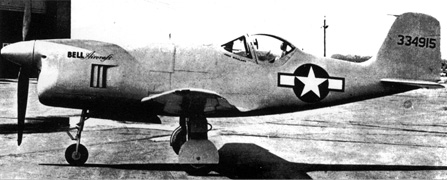
The XP-77 was an experimental all-wood lightweight single-seat fighter which was designed at a time when a shortage of aluminum alloy metals for aircraft appeared imminent.
	Type:           		single-seat fighter
	Crew:           		1, Pilot
	Armament:       		one 20mm cannon, two .50 cal machine guns

	Specifications:
        		Length:         	22' 10.5" (6.9 m)
        		Height:         	8' 2"
        		Wingspan:       	27' 6" (8.38 m)
        		Wing area:      	100 sq. ft (9.29 sq. m)
        		Weight empty:   	2855 lb
        		Weight max:     	4028 lb max at takeoff

	Propulsion:
        		No. of Engines: 	1
        		Powerplant:     	Ranger V-770-7 12-cylinder inline
        		Horsepower:     	575 hp

	Performance:
        		Max speed:      	330 mph at 4000 ft.
        		Ceiling:        	30,100 ft.
        		Range:          	550 miles
Consolidated-Vultee XP-81
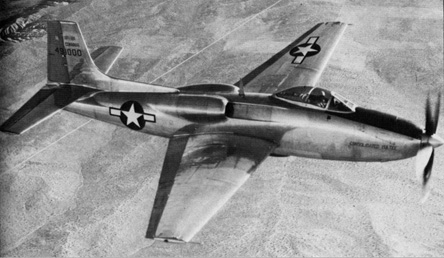
The XP-81 was developed by Consolidated-Vultee for a 1944 USAAF specification for a long-range bomber escort. The aircraft had a conventional layout, but was unconventional in that it had a turbojet engine in the rear fuselage in addition to a turboprop in the nose. Work on the type continued through 1945, but the turboprop used only performed to 60% of expectations, and with the end of the war all production plans were cancelled.
	Type:           		long range escort fighter
	Crew:           		1, Pilot
	Armament:       		six .50 cal machine guns or six 20mm cannon

	Specifications:
	        	Length:         	44' 10" (13.67 m)
        		Height:         	14' 0" (4.27 m)
        		Wingspan:       	50' 6" (15.39 m)
        		Wing area:      	425 sq. ft (39.48 sq. m)
        		Empty Weight:   	12,755 lb (5786 kg)
        		Max Weight:     	24,650 lb (11,181 kg) max at takeoff

	Propulsion:
        		No. of Engines: 	2
        		Powerplant #1:  	General Electric XT31-GE-1 turboprop
        		Powerplant #2:  	Allison J-33-GE-5 turbojet
        		Horsepower #1:  	2300 hp
        		Horsepower #2:  	3750 lb. thrust

	Performance (estimated):
        		Range:          	2500 miles (4023 km)
        		Cruise Speed:   	275 mph ( 443 km/h)
        		Max Speed:      	478 mph ( 769 km/h) at sea level
        		Ceiling:        	35,500 ft (10,820 m)

The Bell YFM-1 Airacuda was an American heavy fighter plane, developed by the Bell Aircraft Corporation during the late-30s. It was the first military aircraft produced by Bell, designated the Bell Model 1. The Airacuda first flew on September 1, 1937. The Airacuda was marked by bold design advances but also numerous flaws that eventually grounded the aircraft. Even though it did see limited production, and one fully operational squadron was eventually formed, only one prototype and 12 production models were ultimately built. Utilizing a streamlined, "futuristic" design, the Bell Airacuda appeared to be unlike any other fighters up to that time.
Type: Heavy Fighter / Bomber Interceptor
Crew: 5, Pilot, Copilot/navigator, Radio operator, two gunners
Armament: two 37mm cannons, two .30 cal machine guns, two .50 cal machine guns, 20 x 30lb fragmentation bombs
Specifications:
Length: 44' 10" (13.67 m)
Height: 13' 7" (4.14 m)
Wingspan: 69' 10" (21.29 m)
Wing area: 684 sq. ft (63.5 sq. m)
Empty Weight: 13,376 lb (6076 kg)
Max Weight: 21,625 lb (9,809 kg) max at takeoff
Propulsion:
No. of Engines: 2
Powerplant: Allison V-1710-9 turbosupercharged
Horsepower: 1090hp each
Performance:
Range: 2600 miles (4184 km)
Cruise Speed: 244mph ( 396 km/h)
Max Speed: 277 mph ( 446 km/h) at sea level
