Rifles
M1/M1A1 Carbine
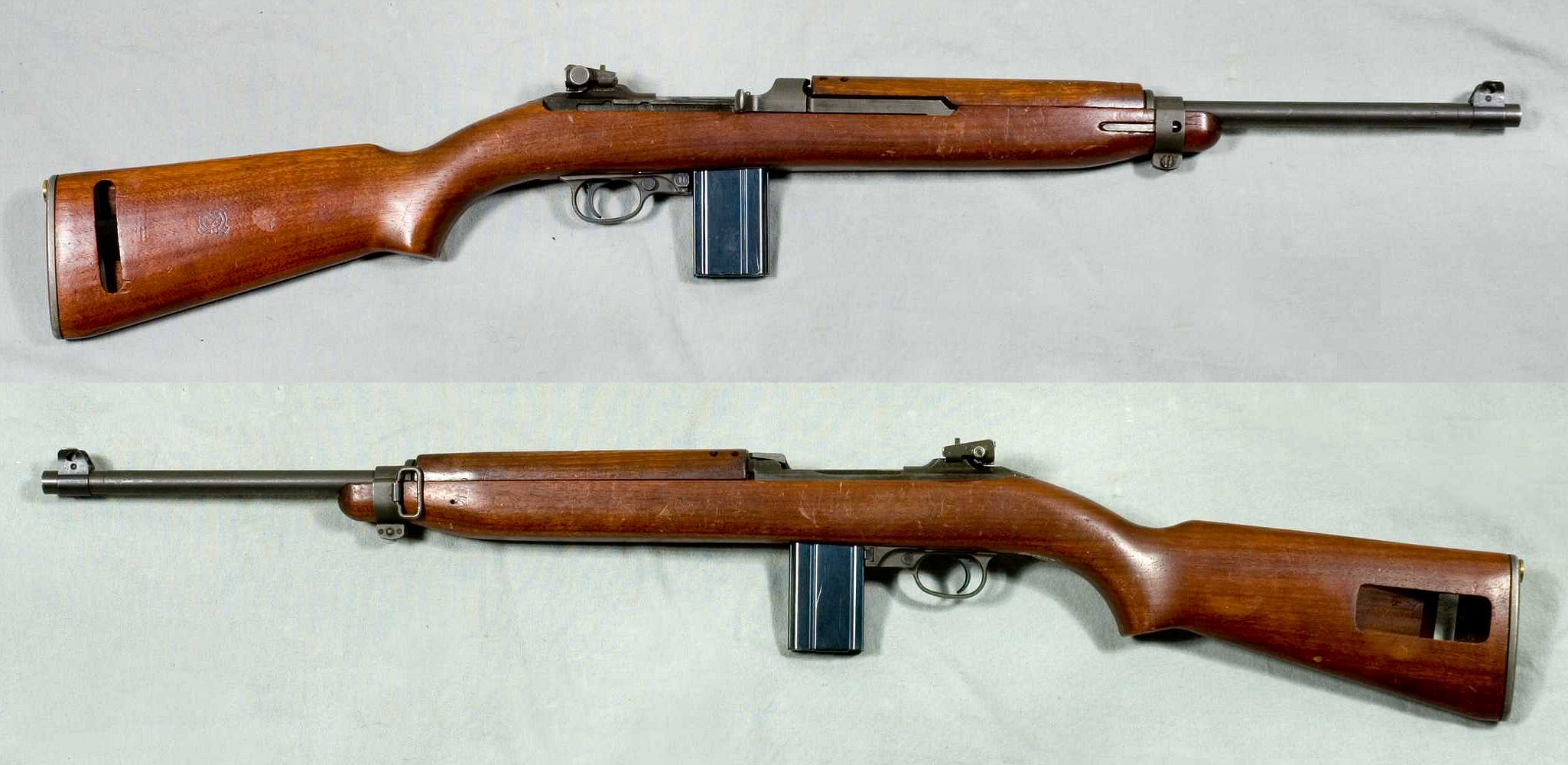
The M1 carbine (formally the United States Carbine, Caliber .30, M1) is a lightweight, easy to use semi-automatic rifle that became a standard firearm for the U.S. Military during World War 2, the Korean War and the Vietnam War, and was produced in several variants. It was widely used by U.S. and foreign military, paramilitary and police forces, and has also been a popular civilian firearm.The first M1 carbines were delivered in mid-1942, with initial priority given to troops in the European Theatre of Operations (ETO). The M1 carbine with its reduced-power .30 cartridge was not originally intended to serve as a primary weapon for combat infantrymen, nor was it comparable to more powerful assault rifles developed late in the war. Nevertheless, the carbine was soon widely issued to infantry officers, American paratroopers, NCOs, ammunition bearers, forward artillery observers, and other frontline troops. Its reputation in front-line combat was mixed. The M1 carbine gained generally high praise for its small size, light weight and firepower, especially by those troops who were unable to use a full-size rifle as their primary weapon. However, negative reports began to surface with airborne operations in Sicily in 1943, and increased during the fall and winter of 1944.
M1 Garand

The M1 Garand (officially designated as United States Rifle, Caliber .30, M1) is chambered for the .30 06 springfield rifle cartridge. It was the first semi-automatic rifle to be generally issued to the infantry of any nation. Called "the greatest battle implement ever devised" by General George S. Patton, the Garand officially replaced the bolt action M1903 Springfield as the standard service rifle of the United States Armed Forces in 1936 and was subsequently replaced by the select fire M14 in 1957. However, the M1 continued to be used in large numbers until 1963 and to a lesser degree until 1966. Like its predecessor, the M1 originated from the Springfield Armory. The M1 "is an air-cooled, gas-operated, clip-fed, and semiautomatic shoulder weapon. The M1 was used extensively by U.S. forces in World War 2, the Korean War, and, to a limited extent, the Vietnam War. Most M1 rifles were issued to soldiers and Marines, though many thousands were also lent or provided as foreign aid to America's allies. The Garand is still used by drill teams and military honor guards. It is also widely sought by the civilian population as a hunting rifle, target rifle, and military collectible.
M1903 Springfield

The M1903 Springfield, formally the United States Rifle, Caliber .30-06, Model 1903, is an American clip-loaded, 5-shot, bolt action service rifle used primarily during the first half of the 20th century. It was officially adopted as a United States military bolt-action rifle on June 19, 1903, and saw service in World War 1. It was officially replaced as the standard infantry rifle by the faster-firing, semi-automatic 8 round M1 Garand, starting in 1937. However, the M1903 Springfield remained in service as a standard issue infantry rifle during World War 2, since the U.S. entered the war without sufficient M1 rifles to arm all troops. It also remained in service as a sniper rifle during World War II, the Korean War and even in the early stages of the Vietnam War. It remains popular as a civilian firearm, historical collector's piece and as a military drill rifle.
Browning Automatic Rifle M1918 A2

The Browning Automatic Rifle (BAR) was a family of United States automatic rifles (or machine rifles) and light machine guns used by the United States and numerous other countries during the 20th century. The primary variant of the BAR series was the M1918, chambered the .30-06 Springfield Rifle Cartridge and designed by John Browning in 1917 for the U.S. Expeditionary Corps in Europe as a replacement for the French-made Chauchat and M1909 Benet-Mercie machine guns. The BAR was designed to be carried by advancing infantrymen, slung over the shoulder or fired from the hip, a concept called "walking fire"—thought to be necessary for the individual soldier during trench warfare. However in practice, it was most often used as a light machine gun and fired from a bipod (introduced in later models). A variant of the original M1918 BAR, the Colt Monitor Machine Rifle, remains the lightest production automatic gun to fire the .30-06 Springfield cartridge, though the limited capacity of its standard 20-round magazine tended to hamper its utility in that role. Although the weapon did see some action in World War 1, the BAR did not become standard issue in the U.S. Army until 1938 when it was issued to squads as a portable light machine gun. The BAR saw extensive service in both World War 2 and the Korean War and saw some service early in the Vietnam War. The BAR has since been replaced by the M249 squad automatic weapon as the standard issue light machine gun in the U.S. Army.
M1917 Enfield Rifle

The M1917 Enfield, the "American Enfield", formally named (United States Rifle Caliber .303 Model 1917) was an American modification and production of the British .303 P14 Rifle developed and manufactured during the period 1917-1918. At the time of the American entry in to World War 2, the U.S. Army was still issuing the M1917 to Chemical Mortarmen. Perhaps due to M1 Garand shortages at the start of the war, the M1917 was also issued to artillerymen early in the war and both mortarmen and artillerymen carried the M1917 in North Africa.
M1941 Johnson Rifle
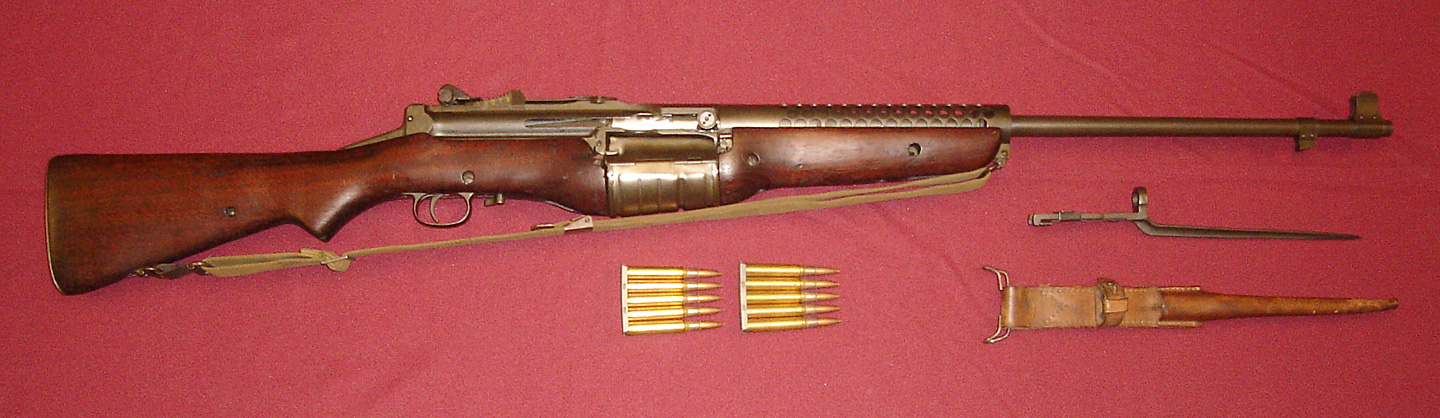
The M1941 Johnson Rifle was an American Short-recoil operated semi-automatic designed by Melvin Johnson prior to World War 2. The M1941 competed unsuccessfully with the U.S. M1 Rifle However, after limited testing, the U.S. Army rejected Johnson's rifle in favor of the M1 rifle developed by Springfield Armory. Despite repeated requests to adopt the rifle by the Marine Corps, the Johnson rifle also lacked the support of US Army Ordnance, which had already invested considerable sums in the development of the M1 and its revised gas operating system, then just going into full production. Johnson was successful in selling small quantities of the M1941 Johnson LMG to the U.S. armed forces, and this weapon was later used by both Para-Marines and the Army's First Special Service Force.
Machine Guns
M1941 Johnson LMG

The M1941 Johnson Light Machine Gun was an American recoil operated Light Machine Gun designed in the late 1930s by Melvin Johnson. Johnson's light machine gun was one of the few to operate on recoil operation and was manufactured to a high standard. It was fed from a curved, single-column magazine attached to the left side of the receiver; company brochures list a 25-round magazine as standard. It shared the same operating principle and many parts with the M1941 Johnson Rifle. During the Second World War, Specials Forces within the Allies demanded a more portable, lighter, more accurate automatic rifle that provided the equivalent stopping power of the American B.A.R. As a result, this machinegun was adapted as the B.A.R replacement for commandos operating behind Axis lines. The weapon has many parallels with the German FG42. Both feed from the left side, and both fire from an open bolt while in automatic, and a closed bolt while in semi-auto. Both weapons were awkward to carry loaded, both with a side-mounted magazine, the Johnson had an especially lengthy single-column magazine, and this feature tended to unbalance the weapons. Despite these similarities, there is no evidence that either weapon had any effect on the design of the other. Both weapons attempted to solve similar problems, and adopted similar solutions.
Browning M 1917 / A1

The M1917 Browning machine gun is a heavy machine gun used by the United States Armed Forces in World War 1, World War 2, and Korea and to a limited extent in Vitnam, and by other nations. It was a belt-fed water-cooled machine gun that served alongside the much lighter air-cooled Browning M1919. It was used at the battalion level, and often mounted on vehicles (such as a jeep). There were two main iterations of it: the M1917, which was used in World War I; and the M1917A1; which was used thereafter. The M1917 was used on the ground and on some aircraft, and had a firing rate of 450 round/min; the M1917A1 had a firing rate of 450 to 600 round/min. The Army adopted the weapon as its principal heavy machine gun, utilizing the M1906 30.06 cartridge with a 150-grain, flat-base bullet. Unfortunately, production was a problem. Several manufacturers started producing the gun, but they had to set up the assembly lines and tooling. By June 30, 1918, Westinghouse had made only 2,500 and Remington had made only 1,600. By the time of the Armistice, Westinghouse had made 30,150, Remington 12,000, and Colt 600.The Model 1917A1 was again used in the Second World War, and was primarily used with the M2 Ball, tracer, and armor-piercing ammunition introduced just prior to the outbreak of hostilities
Browning M1919 A4

The M1919 Browning is a .30 caliber medium machine gun that was widely used during the 20th century. It was used as a light infantry, coaxial, mounted, aircraft, and anti-aircraft machine gun by the U.S. and many other countries, especially during World War 2, the Korean War, and the Vietnam War. Although it began to be superseded by newer designs in the later half of the century (such as by the M60 Machine Gun), it remained in use in many North Atlantic Treaty Organization (NATO) countries and elsewhere for much longer. The Browning M1919 remains popular with civilian enthusiasts in the United States, though changes in 1986 to the National Firearms Act of 1934 (the US Federal law regulating private ownership of machine guns) prohibited the registration of new machine guns for sales to private citizens, thus freezing the number of "transferable" machine guns in private ownership.
Browning M2

The M2 Machine Gun or Browning .50 Caliber Machine Gun, is a heavy machine gun designed towards the end of World War 1 by John Browning. It is very similar in design to Browning's earlier M1919 Browning machine gun, which was chambered for the .30-06 cartridge. The M2 uses the much larger and much more powerful .50 BMG cartridge, which was developed alongside and takes its name from the gun itself (BMG standing for Browning Machine Gun). The M2 has been referred to as "Ma Deuce", or "the fifty" in reference to its caliber. The design has had many specific designations; the official designation for the current infantry type is Browning Machine Gun, Cal. .50, M2, HB, Flexible. It is effective against infantry, unarmored or lightly armored vehicles and boats, light fortifications and low-flying aircraft. The Browning .50 caliber machine gun has been used extensively as a vehicle weapon and for aircraft armament by the United States from the 1920s to the present. It was heavily used during World War 2, the Korean War, the Vietnam War, and during operations in Iraq and Afghanistan in the 2000s (decade). It is the primary heavy machine gun of NATO countries, and has been used by many other countries. The M2 has been in use longer than any other small arm in U.S. inventory except the .45 ACP M1911 pistol, also designed by John Browning.
Sub-Machine Guns
M3 "Grease" Gun

The M3 was an American .45 caliber sub-machine gun adopted for U.S. Army service on 12 December 1942, as the United States Submachine Gun, Cal. .45, M3. The M3 was a superior alternative to the Thompson sub-machine gun as it was cheaper to produce, lighter, more accurate, and was also chambered in .45 ACP. The M3 was commonly referred to as the "Grease Gun" or simply "the Greaser", owing to its visual similarity to the mechanic's tool. Intended as a replacement for the .45-caliber Thompson series of submachine guns, the M3 and its improved successor, the M3A1 began to replace the Thompson in first-line service in late 1944 and early 1945. Due to delays caused by production issues and approved specification changes, the M3/M3A1 saw relatively little combat use in World War 2.
Thompson Sub-Machine Gun

The Thompson is an American sub-machine gun, invented by John T. Thompson in 1919, that became infamous during the Prohibition era. It was a common sight in the media of the time, being used by both law enforcement officers and criminals. The Thompson was also known informally as: the "Tommy Gun", "Trench Broom", "Trench Sweeper", "Chicago Typewriter", "Chicago Piano", "Chicago Style", "Chicago Organ Grinder", and "The Chopper". The Thompson was favored by soldiers, criminals, police and civilians alike for its ergonomics, compactness, large .45 ACP cartridge, reliability, and high volume of automatic fire. It has since gained popularity among civilian collectors for its historical significance. In 1938, the Thompson submachine gun was adopted by the U.S. Military, serving during World War II and beyond. There were two military types of Thompson SMG. The M1928A1 had provisions for box and drum magazines. It had a Cutts compensator, cooling fins on the barrel, employed a delayed blowback action and its charging handle was on the top of the receiver. The M1 and M1A1 had a barrel without cooling fins, a simplified rear sight, provisions only for box magazines, employed a straight blowback action and the charging handle was on the side of the receiver. Over 1.5 million military Thompson submachine guns were produced during World War II.
M50 Reising

The Reising was an American sub-machine gun manufactured by Harrington & Richardson. It was designed and patented by Eugene Reising in 1940. The two primary versions of the weapon produced during World War 2 were the M50 and the simplified folding stock M55. Over 100,000 guns were ordered, and were initially used by the United States Navy, Marine Corps and the United States Coast Guard, though some weapons were shipped to Canadian, Soviet, and other allied forces in the effort against the Axis Powers. Though described as a submachine gun, the Reising was actually designed as a compact lightweight semi-automatic carbine that was also capable of fully automatic fire. The M50 was a selective fire weapon, capable of a fully automatic fire at a rate of 450–600 rounds per minute or semi-automatic fire. As opposed to the then standard Thompson submachine gun, the Reising was lighter, easier to manufacture, and in mass production for the military was priced at approximately $50 per weapon. During World War II, quantities of the M50 Reising gun were issued to U.S. Marine Corps personnel deployed to the Pacific Theatre, and were used in the Solomon Islands Campaign, including the Battle for Guadacanal. Most Reisings were originally issued to Marine officers and NCOs in lieu of a compact and light carbine, since the M1 Carbine was not yet being issued to the Marines. Although the Thompson submachine gun was available, this weapon frequently proved too heavy and bulky for jungle patrols, and initially it too was in short supply.
United Defense M42

The United Defense M42 was an American sub-machine gun in World War 2. It was produced from 1942 to 1943 by United Defense Supply Corp. (a government-formed company specifically tasked with weapons development) for possible issue as a replacement for the Thompson sub-machine gun and was used by agents of the OSS.
The M42 was developed by United Defense Supply Corp. specifically as a replacement for the Thompson sub-machine gun, which the U.S. military considered both expensive and complicated to produce. Made in both 9x19mm Parabellum and .45 ACP prototypes, the 9 mm version was the only one to ever see widespread production. Manufactured by High Standard Firearms, about 15,000 were produced in the last three years of World War II. Only six .45 ACP prototype test guns were made.
M2 Hyde
The Hyde-Inland M2 was the highest-rate United States submachine gun design submitted for trials at Aberdeen Proving Grounds in February, 1941. Work was undertaken by General Motors Inland Manufacturing Division to develop workable prototypes of Hyde's design. The design was designated U.S. Sub-machine gun, Caliber .45, M2 as a substitute standard for the M1 sub-machine gun in April, 1942. As Inland's manufacturing capacity became focused of M1 Carbine production, the US Army contracted M2 production to Marlin Firearms in July, 1942. Marlin began production in May 1943; but Marlin's original contract for 164,450 M2s was canceled in 1943 upon adoption of the M3 sub-machine gun. The M2 is chambered for the .45 ACP cartridge and used the same 20 or 30 round magazine as the Thompson. Its cyclic rate of fire is 525 rounds per minute. Only 400 at the most were manufactured and none were issued by any branches of the United States military.
Handguns
Colt Pocket Hammerless

The Colt Model 1903 Pocket Hammerless is .32 ACP caliber, self-loading, semi-automatic pistol designed by John Browning and built by Colt Patent Firearms Manufacturing Company of Hartford, Connecticut. The Colt Model 1908 Pocket Hammerless is a variant introduced five years later in .380 ACP caliber. Despite the title 'Hammerless', the Model 1903 does have a hammer. It is covered and hidden from view under the rear of the slide. This allowed the weapon to be carried in and withdrawn from a pocket quickly and smoothly without snagging. These pistols were popular civilian firearms for much of their life, and also served as United States General Officer pistols from the 1940s until their replacement by the M15 General Officers pistol in the 1970s. The Office of Strategic Services issued the Model 1903 to its officers during World War 2.
Colt M1911

The M1911 is a single action, semi-automatic magazine-fed, recoil-operated pistol chambered for the .45 ACP cartridge which served as the standard-issue sidearm for the United States Armed Forces from 1911 to 1985. It was widely used in World War 1, World War 2, the Korean War, and the Vietnam War. The M1911 is still carried by some U.S. forces. In total, the United States procured around 2.7 million M1911 and M1911A1 pistols in military contracts during its service life. The M1911 was replaced by the M9 Pistol as the standard U.S. sidearm in the early 1990s, but due to its popularity among users, it has not been completely phased out. World War 2 and the years leading up to it created a great demand. During the war, about 1.9 million units were procured by the U.S. Government for all forces, production being undertaken by several manufacturers, including Remington (900,000 produced), Colt (400,000), Ithaca Gun Company (400,000), Union Switch and Signal (50,000), and Singer (500). So many were produced that after 1945 the government did not order any new pistols, and simply used existing parts inventories to "arsenal refinish" guns when necessary. This pistol was favored by US military personnel.
Colt Official Police

FP45 Liberator
Smith and Wesson Model 10
Shotguns
Ithaca Model 37
Winchester M97 "Trench Gun"
Winchester M12
Browning Auto-5
Knives
Ka-Bar
M1 Bayonet
M1905/1942 Bayonet
Mark 1 Trench Knife
V42 Stiletto
Other
M2 Flamethrower
Bazooka
M18 Recoilless Rifle
MK.2 Frag. Hand Grenade
