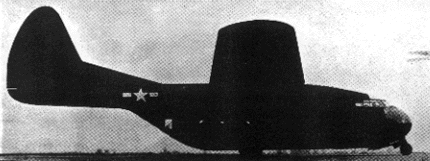
Douglas Dolphin
(also: C-21, C-26)
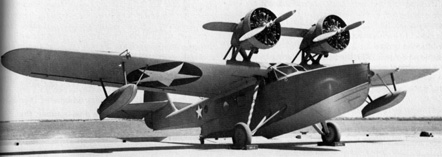
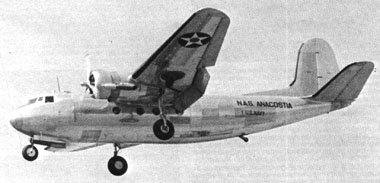
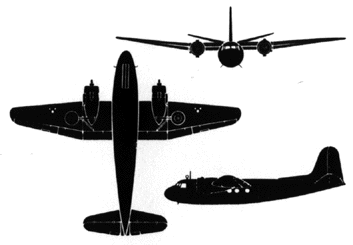
The Dolphin was introduced in 1930 by the Douglas company, and examples were eventually ordered by all the U.S. armed forces, with the first aircraft going to the U.S. Coast Guard. The Dolphins were used for transport and rescue duties, as well as security patrols along the U.S. coastline. Dolphins were recognizable by a aerofoil structure above the engines that was used to provide bracing for the two engines.
Type: amphibian flying boat
Crew: 2, with 6 passengers
Armament: none
Specifications:
Length: 45' 1" (13.74 m)
Height: 14' 0" (4.27 m)
Wingspan: 60' 0" (18.29 m)
Wing area: 592 sq. ft (55.00 sq. m)
Empty Weight: 7000 lb (3175 kg)
Max Weight: 9530 lb (4323 kg) max at takeoff
Propulsion:
No. of Engines: 2
Powerplant: Pratt & Whitney R-1340-96 Wasp radial
Horsepower: 450 hp each
Performance:
Range: 720 miles (1159 km)
Cruise Speed: 135 mph ( 217 km/h)
Max Speed: 156 mph ( 251 km/h) at 9000 ft
Ceiling: 17,000 ft (5180 m)
Douglas DC-2
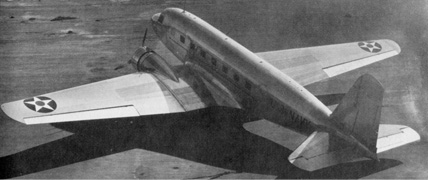
Designed to meet TWA requirements for a new airliner, the DC-1made its first flight in 1933.
Twenty-five examples of the DC-2
were made for TWA in 1934, with examples being procured by the U.S. Navy (as the
R2D-1) and the Army Air Corps. USAAC DC-2's were designated XC-32, C-33, C-38,
and C-39. The DC-2s in military service were used extensively, especially in the
early years of World War II. They are remembered especially for their role in
carrying U.S. survivors from the Phillipines to Australia in December 1941.
Type: 18-seat cargo and passenger transport
Crew: 2
Armament: none
Specifications:
Length: 61' 6" (18.75 m)
Height: 18' 8" (5.69 m)
Wingspan: 85' 0" (25.91 m)
Wing area: 939 sq. ft (87.23 sq. m)
Empty Weight: 14,729 lb (6681 kg)
Max Weight: 21,000 lb (9525 kg) max at takeoff
Propulsion:
No. of Engines: 2
Powerplant: Wright R-1820-55 radial
Horsepower: 975 hp
Performance:
Range: 900 miles (1448 km)
Cruise Speed: 155 mph ( 249 km/h)
Max Speed: 210 mph ( 338 km/h) at 5000 ft
Ceiling: 20,600 ft (6280 m)
Lockheed Model 12-A
(also: C-40,)
In 1935, after the success of the model 10 Electra, Lockheed set out to
design a similar, but smaller, twin-engined aircraft. The resultant Model 12 was
one of the first aircraft intended for business use, seating six passengers in a
well-furnished cabin. A total of 114 were built before production ceased in
1942. The U.S. military also acquired a number of Model 12-As for transport
duty, these being designated JO-1 and JO-2s for the U.S. Navy and Marines, and
C-40s & UC-40s for the U.S. Army Air Corps. Military Model 12s were
initially built in a seven-seat configuration. Sixteen armed versions (with two
.50 caliber machine guns and underwing bomb racks) were also ordered by the
Netherlands.
Type:		light transport/gunnery trainer
Crew:		6-7
Armament:	two 0.50 inch machine guns
		up to 2,000 lbs. of bombs

Specifications:
	Length:        	36' 4" (11.07 m)
	Height:        	9' 9" (2.97 m)
	Wingspan:      	49' 6" (15.09 m)
	Wing area:	352 sq. ft (32.70 sq. m)
	Empty Weight:  	5960 lb (2703 kg)
	Max Weight: 	9200 lb (4173 kg) max at takeoff

Propulsion:
	No. of Engines:	2
	Powerplant:    	Pratt & Whitney R-985-SB Wasp Junior radial
	Horsepower:	450 hp

Performance:
	Range:		800 miles (1287 km)
	Cruise Speed:   212 mph ( 341 km/h)
	Max Speed:      225 mph ( 362 km/h)
	Ceiling:       	22,900 ft (6980 m)
Beechcraft Model 18/UC-45 Expeditor
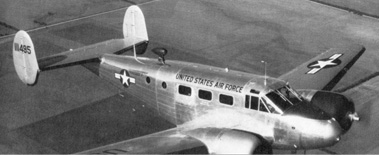
The USAAC first ordered this type of aircraft in 1940 under the designation
C-45, for use as a staff transport. These aircraft were re-designated UC-45s in
1943. Other variants included the AT-7 Navigator, introduced in 1941 for
navigator training. This had a dorsal astrodome and positions for three
trainees. Some 577 of these were built. 1941 also saw the introduction of the
AT-11 Kansan, which was a bombing/gunnery trainer. Production of the AT-11
totaled 1,582, and included 36 examples completed as the AT-11A navigation
trainer. Another Model 18 variant was the F-2 photo-reconnaissance model, of
which 69 examples were acquired. The U.S. Navy and Marine Corps also procurred
the Model 18, with a total of over 1,500 examples. The JRB-1 was the equivalent
of the F-2, the JRB-2 was a transport, and the JRB-3 and -4 were the equivalent
of the UC-45. The SNB-1, -2, & -3 were the equivalents of the AT-11, -7, and
-7C, respectively. The F-2 was yet another variant of the Model 18 that was
built to carry two to four aerial cameras and used for reconnaissance and aerial
mapping. Only about 70 of the F-2 models were built. Other variants of the Model
18 included an air ambulance and a electronics countermeasure
trainer.
Type:           navigation and bombing trainer
Crew:           ?, plus 3 trainees
Armament:       none

Specifications:
        Length:         34' 2" (10.41 m)
        Height:         9' 8" (2.95 m)
        Wingspan:       47' 8" (14.53 m)
        Wing area:      349 sq. ft (32.42 sq. m)
        Empty Weight:   6175 lb (2801 kg)
        Max Weight:     8727 lb (3959 kg) max at takeoff

Propulsion:
        No. of Engines: 2
        Powerplant:     Pratt & Whitney R-985-AN-1 radial
        Horsepower:     450 hp

Performance:
        Range:          850 miles (1368 km)
        Cruise Speed:   (not listed)
        Max Speed:      215 mph ( 346 km/h)
        Ceiling:        20000 ft (6095 m)
Curtiss C-46 Commando
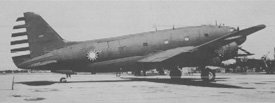
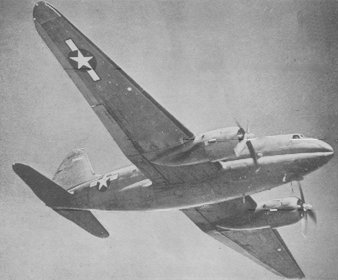
The Curtiss C-46 Commando served a similar role as its contemporary the Douglas C-47 Skytrain, but was not quite
as famous or as heavily produced. The Navy/USMC version was known as the R5C.
Type:           54 seat military transport and troop carrier
Crew:           3, Pilot, co-pilot, radio operator
Armament:       none

Specifications:
        Length:         76' 4" (23.27 m)
        Height:         21' 9" (6.63 m)
        Wingspan:       108' 1" (32.94 m)
        Wing area:      1360 sq. ft (126.34 sq. m)
        Empty Weight:   32,400 lb (14,696 kg)
        Max Weight:     56,000 lb (25,401) max at takeoff

Propulsion:
        No. of Engines: 2
        Powerplant:     Pratt & Whitney R-2800-51 Double Wasp radial
        Horsepower:     2000 hp each

Performance:
        Range:          1200 miles (1931 km)
        Cruise Speed:   183 mph ( 295 km/h)
        Max Speed:      269 mph ( 433 km/h) at 15,000 ft
        Ceiling:        27,6000 ft (8410 m)
Douglas C-47 Skytrain
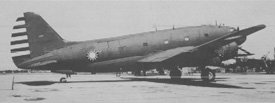
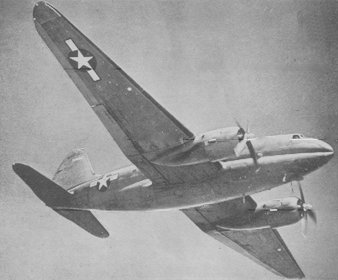
The C-47 Skytrain was the most commonly used transport in the Allied Air Forces and has operated in every theater of war. A version was even built under license by the Japanese (the Showa L2D), as well as by the Russians (the Lisunov Li-2). It was known under different designations (C-47, C-53, R4D) and different names (Skytrain/Skytrooper/Dakota/"Gooney Bird"), and by the civilian designation DC-3. DC-3B's taken over from airlines were given the military designations C-49 or C-84. A special staff transport model was designated C-117, but only seventeen were built. The C-47 was famous for its dependability, versatility, and ability to carry loads far heavier than the official specs allowed. Famous campaigns involving the C-47 were "flying the Hump" (transport over the Himalyas), dropping paratroops behind enemy lines on D-Day, and the post-war Berlin airlift. The C-47 was so useful that it was used by the U.S. military in WWII, Korea, and Vietnam, and many are still flying in different countries around the world today.
Type: Military transport and glider tug Crew: 3, Pilot, co-pilot, radio operator Armament: none Specifications: Length: 64' 2.5" (19.57 m) Height: 16' 11" (5.16 m) Wingspan: 95' 0" (28.96 m) Wing area: 987 sq. ft (91.69 sq. m) Empty Weight: 16970 lbs (7698 kg) Takeoff Weight: 26,000 lbs (11,793 kg) maximum Propulsion: No. of Engines: 2 Powerplant: Pratt & Whitney R-1830-93 Twin Wasp Horsepower: 1200 hp each Performance: Range: 1500 miles (2414 km) Cruise Speed: 185 mph (298 km/hr) at 10,000 ft. Max Speed: 229 mph (369 km/hr) aat 7,500 ft. Climb: 1130 ft/min (345 m/min) Ceiling: 23,200 ft (7,070 m)
Douglas C-54 / R5D Skymaster

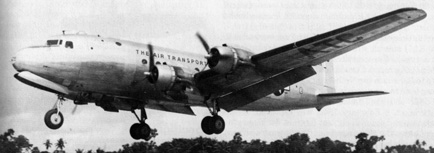
Like its stable mate the DC-3/C-47 Skytrain, the C-54 Skymaster was derived from the prototype of a civilian airliner (the DC-4). C-54s began service with the USAAC in 1942, carrying up to 26 passengers. (Later versions carried up to 49 passengers.) The U.S. Navy also acquired the type, under the designation R5D. The C-54/R5D was one of the most commonly used transports by the U.S. armed forces in World War II.
Type: cargo and passenger transport Crew: 6 Armament: none Specifications: Length: 93' 11" (28.63 m) Height: 27' 6.25" (8.39 m) Wingspan: 117' 6" (35.81 m) Wing area: 1463 sq. ft (135.91 sq. m) Empty Weight: 38,000 lb (17,237 kg) Max Weight: 73,000 lb (33,112 kg) max at takeoff Propulsion: No. of Engines: 4 Powerplant: Pratt & Whitney R-2000-7 radial Horsepower: 1350 hp each Performance: Range: 3900 miles (6276 km) Cruise Speed: 239 mph ( 385 km/h) Max Speed: 274 mph ( 441 km/h) at 14,000 ft Ceiling: 22,000 ft (6705 m)
Lockheed Model 18 Lodestar

Last in the line of twin-engined commercial transports, the Model 18
Lodestar was first flown in September 1939. In 1940 the U.S. Navy acquired 3
examples (as R5O-1s), and the Coast Guard acquired one. Twelve R5O-4s, 41
R5O-5s, and 35 R5O-6s were also later acquired. These were used by the Marines as well as the Navy. The USAAC began acquiring examples in 1941, designating them the C-56, C-57 and C-60, with some of the Model 18s being impressed from civilian service.
Type: personnel and cargo transport Crew: 3, plus 14-17 passengers Armament: none Specifications: Length: 49' 10 (15.19 m) Height: 11' 1" (3.38 m) Wingspan: 65' 6" (19.96 m) Wing area: 550 sq. ft (51.10 sq. m) Empty Weight: 11,650 lb (5284 kg) Max Weight: 17,500 lb (7938 kg) max at takeoff Propulsion: No. of Engines: 2 Powerplant: Wright R-1820-71 radial Horsepower: 1200 hp each Performance: Range: 1600 miles (2575 km) Cruise Speed: 200 mph ( 322 km/h) Max Speed: 253 mph ( 407 km/h) Ceiling: 23,300 ft (7100 m)Noorduyn Norseman (UC-64)
NOTE: This is not an American aircraft (it was built by a Canadian company), but the type was used by the American military in WWII.
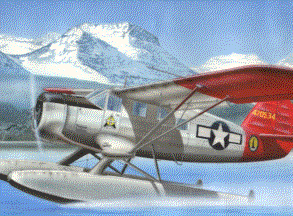
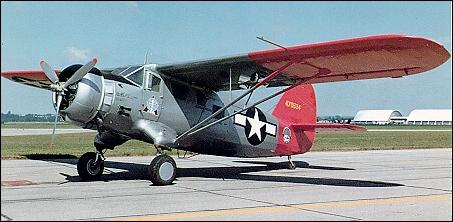
The UC-64A is a ten-place, single-engine utility transport manufactured by the Noorduyn Aviation, Ltd., Montreal, Canada. First flown in 1935, the Norseman was designed for rugged Canadian bush country operations and could be equipped with wheels, floats, or skis. Before WW II, 69 were delivered to the Royal Canadian Air Force as trainers. After service testing seven YC-64s, the U.S. Army Air Forces adopted the aircraft in 1942 as a light transport. Noorduyn produced 762 Norseman for the USAAF before the war ended. Of these, 749 were UC-64As, including three that went to the Navy as JA-1s and six that were equipped with floats for the U.S. Army Corps of Engineers. The last Norseman was produced in late 1959. Designed for and used in arctic areas, the Norseman also was employed in Europe and the Pacific as well as in the U.S. during the war. On Dec. 15, 1944, a UC-64A disappeared on a flight from England to France with bandleader Major Glenn Miller on board. The aircraft was never found. (It is believed that while over the Channel a returning flight of RAF bombers accidently knocked the low-flying Norseman out of the sky when it salvoed its bombload directly over the unsuspecting transport.)
Type: utility transport aircraft Crew: 1, plus 9 passengers Armament: none Specifications: Length: 32' 0" (9.8 m) Height: 10' 3" (3.1 m) Wingspan: 51' 6" (15.7 m) Wing area: 325 sq. ft. (30.20 sq. m) Empty Weight: 4680 lb (2123 kg) Gross Weight: 7400 lb (3357 kg) max at takeoff Propulsion: No. of Engines: 1 Powerplant: Pratt & Whitney R-1340-AN-1 Wasp radial Horsepower: 600 hp Performance: Range: 1550 miles (1851 km) Cruise Speed: 148 mph ( 238 km/h) Max Speed: 162 mph ( 261 km/h) Ceiling: 17,000 ft (5182 m)
Lockheed C-69 Constellation
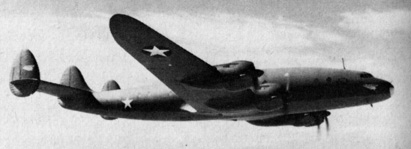
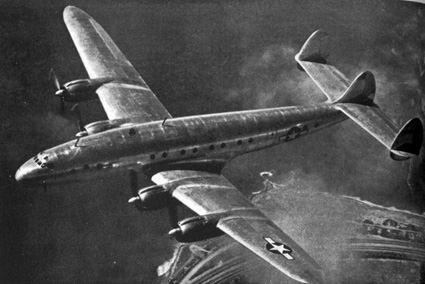
The Constellation was developed as a four engined civilian airliner,
and in that role (after the war) it became the most elegant and certainly one of
the most successful airliners ever produced by US industry. In 1943, however,
when the prototype took its maiden flight, the U.S. was at war and needed a fast
military transport. Production of the new airliner was converted into the C-69
military version, which was produced until the war's end, when the civilian
airliner was once again produced. 856 Constellations were built during the
production run of the aircraft, though only 21 were built to USAAF
specifications before the war's end (and not all of those entered service).
After the war all of examples of the C-69 were sold to civil
operators.
Type:		cargo and passenger transport
Crew:		4
Armament:	none

Specifications:
	Length:        	95' 2" (29.01 m)
	Height:        	23' 8" (7.21 m)
	Wingspan:      	123' 0" (37.49 m)
	Wing area:	1650 sq. ft (153.29 sq. m)
	Empty Weight:  	50,500 lb (22,906 kg)
	Max Weight: 	72,000 lb (32,659 kg) max at takeoff

Propulsion:
	No. of Engines:	4
	Powerplant:    	Wright R-3350-35 Cyclone 18 radial
	Horsepower:	2200 hp each

Performance:
	Range:		2400 miles (3862 km)
	Cruise Speed:   300 mph ( 483 km/h)
	Max Speed:      330 mph ( 531 km/h)
	Ceiling:       	25,000 ft (7620 m)
Boeing C-73
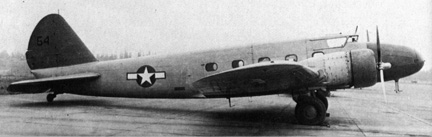
Some 27 Boeing Model 247D airliners were impressed for USAAF service
(under the designation C-73), but their limited payload and small doors dictated
their use for secondary tasks such as pilot ferrying before they were returned
to civil use in 1945.
Type:		transport
Crew:		3, plus 10 passengers
Armament:	none

Specifications:
	Length:        	51' 7" (15.72 m)
	Height:        	(not listed)
	Wingspan:      	74' 0" (22.56 m)
	Wing area:	836 sq. ft (77.66 sq. m)
	Empty Weight:  	(not listed)
	Max Weight: 	13,650 lb (6192 kg) max at takeoff

Propulsion:
	No. of Engines:	2
	Powerplant:    	Pratt & Whitney R-1340-AN-1 Wasp radial
	Horsepower:	600 hp each

Performance:
	Range:		745 miles (1199 km)
	Cruise Speed:   189 mph ( 304 km/h)
	Max Speed:      200 mph ( 322 km/h)
	Ceiling:       	25,400 ft (7740 m)
Douglas C-74 Globemaster
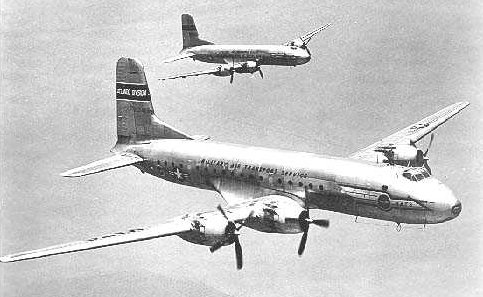
The C-74 Globemaster was a long range heavy transport aircraft built by
Douglas Aircraft. It was a greatly enlarged development of the DC-4. Initially
the C-74 also used the DC-7 designation, but that was reused later for a
commercial type. The initial contract for 50 aircraft was placed in 1942, though
the end of the war caused the number completed to be cut to 14. Of the 14
Globemasters built, 12 were delivered to the USAAF between October 1945 and
April 1947. One C-74 crashed during flight testing, and one was used for
destructive load testing. The first flight occured on September 5th, 1945. When
the C-74 eventually went into service it was the largest land-based transport in
the world. It was designed to carry 125 troops or up to 48,000 lbs of cargo.
The use of the C-74 during the Berlin airlift convinced the USAAF of the need
for an advanced cargo aircraft, and Douglas went on to develop the larger C-124
Globemaster II from the Globemaster I program. The C-74 remained in service
until 1959.
Type:		Military transport
Crew:		4 or 5
Armament: 	none

Specifications:
	Length:		124' 2" (37.85 m)
	Height:		43' 9" (13.34 m)
	Wingspan:	173' 3" (52.81 m)
	Wing area:	987 sq. ft (91.69 sq. m)
	Empty Weight: 	? lbs (39087 kg)
	Takeoff Weight:	165,000 lbs (78018 kg) maximum

Propulsion:
	No. of Engines:	4
	Powerplant: 	Pratt & Whitney R-4360-27 radials
	Horsepower:	3000 hp each

Performance:
	Range:		7,200 miles (12550 km)
	Cruise Speed: 	260 mph
	Max Speed:	312 mph
	Climb:		1130 ft/min (345 m/min)
	Ceiling:	30,000 ft (6645 m)
Boeing C-75
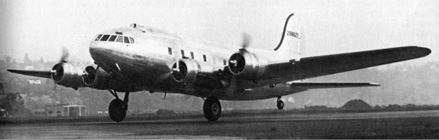
Developed from the Boeing Model 299 (the prototype of the famous
B-17 Flying Fortress), the Model 300 was meant for civil service. The
circular-section fuselage was much more spacious, and when it was decided to
moderately pressurize the cabin, the designation was changed to the Model 307. Ten Model 307s were built, five of which went to TWA airlines. These five were impressed into USAAF service in 1942, receiving the designation C-75. For two and a half years these five aircraft made a total of approximately 3,000 transatlantic crossings as VIP transports. They were then released from military service and returned to Boeing for conversion back to airline standards.
Type:		long range VIP transport
Crew:		5, plus 33 passengers
Armament:	none

Specifications:
	Length:        	74' 4" (22.66 m)
	Height:        	20' 9.5" (6.34 m)
	Wingspan:      	107' 0" (32.61 m)
	Wing area:	1486 sq. ft (138.05 sq. m)
	Empty Weight:  	30,000 lb (13,608 kg)
	Max Weight: 	45,000 lb (20,412 kg) max at takeoff

Propulsion:
	No. of Engines:	4
	Powerplant:    	Wright GR-1820 Cyclone radial
	Horsepower:	900 hp each

Performance:
	Range:		910 miles (1464 km)
	Cruise Speed:   220 mph ( 354 km/h)
	Max Speed:      246 mph ( 396 km/h)
	Ceiling:       	26,200 ft (7985 m)
Curtiss C-76
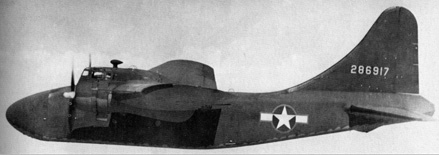
The C-76 was designed as an all-wood transport aircraft because of
fears that metal resources might not be available in a long war. When these
fears failed to materialize, production was canceled after 15 examples were made
and delivered.
Type: advanced trainer Crew: 2 Armament: none Specifications: Length: 68' 4" (20.83 m) Height: (not listed) Wingspan: 108' 2" (32.97 m) Wing area: (not listed) Empty Weight: (not listed) Max Weight: 28,000 lb (12,700 kg) max at takeoff Propulsion: No. of Engines: 2 Powerplant: Pratt & Whitney R-1830-92 Twin Wasp radial Horsepower: 1200 hp each Performance: Range: (not listed) Cruise Speed: (not listed) Max Speed: 200 mph (322 km/h) Ceiling: (not listed)
Fairchild C-82 Packet

The design of the Fairchild C-82 Packet was begun in 1941, with the
mockup being approved by the Army in 1942. Development time was only 21 months,
resulting in the first flight being taken on September 10, 1944. It was put into
production by both Fairchild and North American, but at the end of the war
military production was reduced by 80%, and the North American contract was
cancelled.
Type: Cargo and troop transport Crew: 3 Armament: none Specifications: Length: 75' 10.25" (23.1 m) Height: 26' 4" (8 m) Wingspan: 106' 0" (32.1 m) Wing area: 1400 sq. ft. (130.9 sq. m) Empty Weight: 16,530 lb (12,045 kg) Weight loaded: 42,000 lb (19,050 kg) Propulsion: No. of Engines: 2 Powerplant: Pratt & Whitney R-2800-22 radial Horsepower: 2100 hp each
Budd C-93/RB-1 Conestoga

The Budd C-93 Conestoga was the first aircraft of original design to
be fabricated entirely of shotwelded stainless steel. It was designed to meet a
U.S. Navy specification for a twin-engined cargo carrier and troop transport.
The Army version was known as the C-93, but the initial order was canceled due
to delays caused by manufacturing problems. The Navy version was designated the
RB-1, but only 25 of the initial 200 ordered were delivered before cancellation
of that order.
Type: transport Crew: ? Armament: none Specifications: Length: 68' 0 (20.7 m) Height: 31' 9" (9.68 m) Wingspan: 100' 0" (30.5 m) Wing area: 1400 sq. ft. (130 sq. m) Empty Weight: 20,156 lb (9,150 kg.) Weight loaded: 33,860 lb (15,372 kg) Propulsion: No. of Engines: 2 Powerplant: Pratt & Whitney R-1830-92 Twin Wasp radial Horsepower: 1200 hp each Performance: Range: 1620 miles (2590 km) Cruise Speed: 165 mph (264 km/h) Max Speed: 197 mph (315.2 km/h)at 7500 ft Ceiling: (not listed)
Waco CG-3A

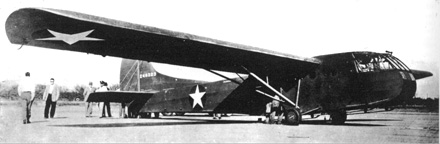
The Waco CG-3 was the USAAF's first production troop-carrying glider, but 200 of the 300 ordered under the designation CG-3A were cancelled, the 100 built being used as trainers for the pilots needed to man the improved CG-4A.
Type: troop-carrying glider Crew: 2, plus 7 troops Armament: none Specifications: Length: 43' 4" (13.21 m) Height: (none listed) Wingspan: 73' 1" (22.28 m) Wing area: (none listed) Empty Weight: 2044 lb (927 kg) Max Weight: 4400 lb (1996 kg) max at takeoff Performance: Max towing speed: 120 mph ( 193 km/h) Normal tow speed: 100 mph ( 161 km/h) Min control speed: 38 mph ( 61 km/h)Waco CG-4A

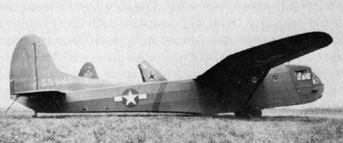
Considered to be very suitable as a troop/cargo glider, the CG-4A could carry 13 troops, or cargo loads that could include a Jeep with a crew of four plus equipment, or a 75mm howitzer with its guncrew of three, ammunition, and supplies. The first examples of the CG-4A began to enter service with the US Army Air Corps during 1942, with production reaching its peak in 1942-43. CG-4As were used in the invasion of Sicily, Chindit actions in Burma, the invasion of Normandy and southern France, at Arnhem, and during the Rhine crossings. They were also used by the RAF, but only operationally at Sicily.
Type: troop-carrying glider Crew: 2 crew, and 13 troops Armament: none Specifications: Length: 48' 8" (14.83 m) Height: 12' 7" (3.84 m) Wingspan: 83' 8" (25.50 m) Wing area: 852 sq ft. (79.15 m squared) Empty Weight: 3700 lb (1678 kg) Max Weight: 9000 lb (4082 kg) max at takeoff Performance: Max towing speed: 150 mph ( 241 km/h) Normal tow speed: 120 mph ( 193 km/h)Waco CG-13A

The Waco CG-13A assault glider could carry up to 42 troops or an
equivalent weight of cargo. It was developed as a glider based on the CG-4A, but with
double the capacity. Orders began in 1943, with 132 being made by Ford and Northwestern and delivered through 1945.
Type: troop-carrying glider Crew: 30-42 troops Armament: none Specifications: Length: 54' 4" (16.56 m) Height: 20' 3" (6.17 m) Wingspan: 85' 8" (26.11 m) Wing area: 873 sq. ft (81.10 sq. m) Empty Weight: 8700 lb (3946 kg) Max Weight: 18,900 lb (8573 kg) max at takeoff Performance: Max towing speed: 190 mph ( 306 km/h) landing speed: 80 mph ( 129 km/h)Waco CG-15A
An improved version of the CG-4A, the CG-15A
still carried 15 troops, though at a higher speed.
Type: troop-carrying glider Crew: 15 troops Armament: none Specifications: Length: 48' 10" (14.88 m) Height: (none listed) Wingspan: 62' 2.25" (18.95 m) Wing area: 623 sq. ft (57.88 sq. m) Empty Weight: 4000 lb (1814 kg) Max Weight: 8035 lb (3645 kg) max at takeoff Performance: Max towing speed: 180 mph ( 290 km/h)
Douglas DC-5 / R3D
The Douglas DC-5 was developed as a 16/22 passenger civilian airliner, with a high wing and tricycle landing gear. Four examples were produced for KLM Airlines, and were used to evacuate civilians from Java to Australia in 1942. One of these aircraft was damaged and captured by the Japanese, who extensively test flew it. The earliest U.S. DC-5 military operations were by the U.S. Navy who had ordered seven examples in 1939. Three were R3D-1 16-seat personnel carriers, and four were R3D-2s (22 seat paratrooper version) for the U.S. Marine Corps. The prototype was sold to William Boeing, but was later impressed into the U.S. Navy as the sole R3D-3.
Type: cargo and passenger transport Crew: 6 Armament: none Specifications: Length: 62' 6" (19.05 m) Height: 19' 10" (6.05 m) Wingspan: 78' 0" (23.77 m) Wing area: 824 sq. ft (76.55 sq. m) Empty Weight: 13,674 lb (6,202 kg) Max Weight: 20,000 lb (9,072 kg) max at takeoff Propulsion: No. of Engines: 2 Powerplant: Wright GR-1820-F62 radial Horsepower: 850 hp each Performance: Range: 1600 miles (2575 km) Cruise Speed: 202 mph ( 325 km/h) Max Speed: 221 mph ( 356 km/h) at 7,700 ft Ceiling: 23,700 ft (7225 m)
Allied LRA-1

Prior to WWII many military services experimented with gliders in training and cargo-carrying roles. The early successes of the Germans in the beginning of the war caused the U.S. to increase their attentions on the possibility of military gliders. While the U.S. Navy had shown some interest in the subject as far back as 1920, 1940 brought new efforts to explore the concept of a flying boat glider. The Allied Aviation Corporation made two wooden prototypes, with four more ordered from the Bristol Aeronautical Corporation. 100 examples of the type were eventually ordered from each of the two companies, but the orders were cancelled in 1943 when it was decided that the needs could be met by more conventional powered aircraft.
Type: flying boat transport glider Crew: 2, plus 10 troops Armament: none Specifications: Length: 40' 0" (12.19 m) Height: 12' 3" (3.73 m) Wingspan: 72' 0" (21.95 m)
Laister-Kauffman XCG-10A

Additional info from Charles Day, "The XCG-10 and XCG-10A were two different craft. The 10 was a 30 place glider and the 10A was 42 place. Although some sources say the 10 did not exist and the project was changed to 10A in design stage, the 10 was built both as a static test article and a flight test article. The internal hold size was slightly larger for the 10A to accomodate the GM 6X6 truck. The wingspan stayed the same."
Type: cargo glider (experimental) Crew: 2 Armament: none